

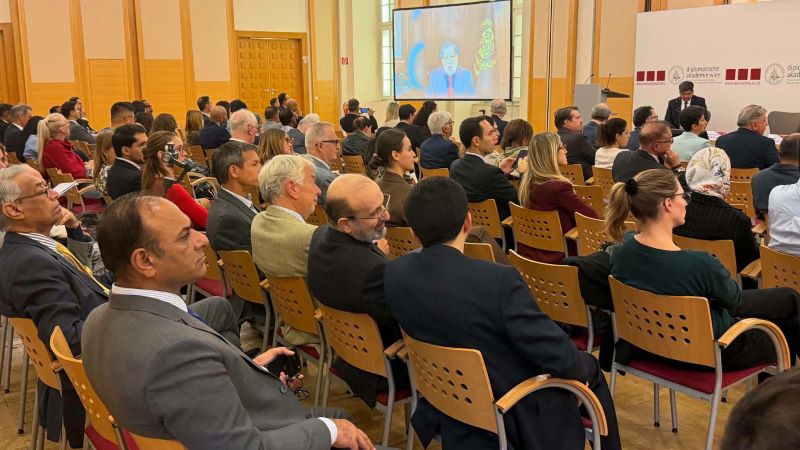
From Indus to Nile: Vienna summit maps global water flashpoints
Last night, an important international event was organised by the Embassy of Pakistan in collaboration with the Diplomatic Academy of Vienna. The event focused on the use and sharing of international rivers among different countries. Two key speakers, Pakistan’s Deputy Prime Minister and Foreign Minister, Ishaq Dar, and Pakistan’s Indus Water Commissioner, Syed Mehar Ali Shah, participated virtually.
During his online address, Deputy Prime Minister and Foreign Minister Ishaq Dar warned that any attempt to deny Pakistan its rightful share of the Indus waters could have serious consequences for regional peace and security. He stressed the importance of fair water-sharing, reminding the international community that water is not merely a natural resource, but also a lifeline for millions of people and a vital foundation for peace, stability, and cooperation among nations.
Speaking by video at the International Water Symposium in Vienna, he stressed that the 1960 Indus Waters Treaty (IWT) remains fully in force after a unanimous August 2026 arbitral award ordered India to uphold its obligations and restricted work on a contested hydropower project.
Dar said the treaty contained no clause allowing unilateral suspension, and that India’s 2025 move to place it “in abeyance” violated basic principles of international law, including pacta sunt servanda agreements must be kept.
He called for implementation of the IWT “in letter and spirit”, resolution of all disputes through its mechanisms, and enhanced technical transparency and data-sharing.
Pakistan’s Indus Water Commissioner, Syed Mehar Ali Shah, has separately cautioned that while current Indian manipulations of river flows are manageable, new upstream storage could breach the treaty and extend disruptions from days to weeks, heightening risks for Pakistan’s agriculture and energy.
Ambassador of Pakistan Mohammad Kamran Akhtar Malik, in his opening keynote, outlined the IWT in detail as a rare, binding framework for sharing transboundary rivers.
The symposium offered a wide angle view of global water stress; Egypt’s Ambassador Nasr Salem described how African states manage scarce supplies through national planning and ad hoc arrangements, noting the continent still lacks basin wide accords comparable to the IWT.
Envoys from Turkey, Tajikistan and Vietnam recounted conflicts and tensions in their regions, from upstream dam projects to competing irrigation and energy needs. University Professor Ayşegül Kibaroğlu surveyed international water law, highlighting core principles such as equitable and reasonable use, the duty to prevent significant harm, and the growing gap between legal norms and practice on contested rivers.





