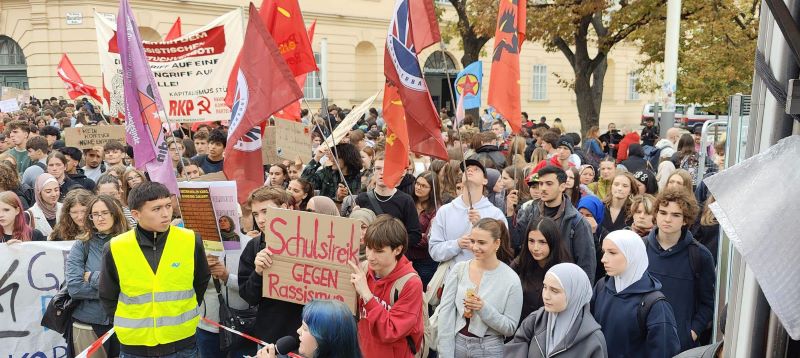
Hundreds of students took to the streets on Friday to protest Austria’s ban on headscarves for girls under the age of 14 on school grounds. The demonstrators also called for more public money to be invested in education, arguing that schools should support young people rather than control their lives, reported by News ORF.
Since the ban came into force at the start of this school year, schools have followed a series of steps when a student continues to wear a headscarf. Teachers first remind her of the rule. If she breaks it again, her parents are invited to a meeting with school management. The next step is a meeting at the regional education directorate. According to the figures cited in the report, 127 such meetings have taken place since the school year began, and 52 cases have led to official reports because girls continued to attend school with their heads covered.
Friday’s demonstrations were organised by youth groups linked to Austria’s Social Democratic Party (SPÖ): the Socialist Youth, the Action of Critical Students (AKS) and the Red Falcons. They joined forces with communist youth organisations and the initiative “Schule brennt” (“School Is Burning”). Several hundred people gathered in Vienna for what organisers called a school strike against the ban. Protests were also announced in other federal states, with calls to stand against “racism, sexism and militarisation”.
The demonstrations addressed a range of issues. Some protesters criticised the headscarf ban with slogans such as “Dude, keep your hands off the girls’ heads”. Others demanded more money for education instead of spending on banks or bombs. Speaking at the rally, an AKS representative who wore a headscarf said schools should empower girls, not make decisions about their lives without listening to them. Other speakers struck a more combative tone, calling for further protests to overturn the ban.
Vienna has reported by far the largest number of cases. According to figures from the Education Ministry, as of 8 October there had been 210 meetings at the city’s education directorate. In 53 cases, authorities filed reports over repeated violations. The district administrative authorities can impose fines ranging from €150 to €800, and these penalties can be issued more than once.
The number of potentially affected girls is relatively high in Vienna. During the previous school year, four out of every ten children and teenagers in the capital were registered as belonging to the Islamic faith.
The other federal states have reported few meetings with education officials, or none at all. Burgenland, for example, has reported no such meetings. However, some states have recorded a relatively high number of reports compared with the number of meetings. This may be because some families have been reported more than once or because parents did not attend the requested meeting.
Lower Austria recorded eleven reports and nine meetings, followed by Salzburg with nine reports and four meetings. Styria reported seven cases and ten meetings, Upper Austria four reports and six meetings, and Vorarlberg three reports and seven meetings. In Carinthia and Tyrol, no reports have yet been sent to the district authorities. There have been only two meetings in Carinthia and four in Tyrol.
The Education Ministry said there was no unusual concentration of violations at particular schools. Even at Islamic schools, where more girls may be affected by the rule, the vast majority were reportedly following it.
Education Minister Christoph Wiederkehr of the liberal NEOS party said he was satisfied with how the ban had been implemented. In a statement, he said the figures showed that most students and parents were cooperating and that information provided before the ban came into force had been effective. Meetings with parents after a violation had been “largely successful”, he said. Where further violations occurred, administrative fines would be imposed.
This is Austria’s second attempt to restrict the wearing of headscarves in schools. In the autumn of 2019, the government at the time introduced a ban that applied only to primary schools. However, a little more than a year later, Austria’s Constitutional Court overturned the law. It ruled that a measure targeting Muslims in particular was incompatible with the state’s duty to remain religiously neutral.
The current ban, which applies to girls up to the age of 14, the age at which they reach religious maturity under the law has also been challenged in the Constitutional Court. A decision is expected in the first half of 2027.