At least 64 people have died after two high speed trains collided near Toledo in central Spain, in the country’s second deadly rail disaster this year. Rescue teams searched carriage by carriage through the wreckage on Wednesday, fearing the toll could rise further.
The crash involved a train operated by state owned Renfe and another run by the private consortium Iryo. According to a person briefed on the disaster, the Iryo train had stopped near Toledo after infrastructure manager ADIF ordered it to halt because of a signal fault. The Renfe train then struck the stationary train at high speed, derailing carriages from both services.
Renfe said its train had been authorized to continue before the collision, but said it did not know why the Iryo train remained stopped. It added that the exact sequence of events and circumstances of the impact would be established by investigators. Neither Iryo nor ADIF immediately responded to requests for comment.
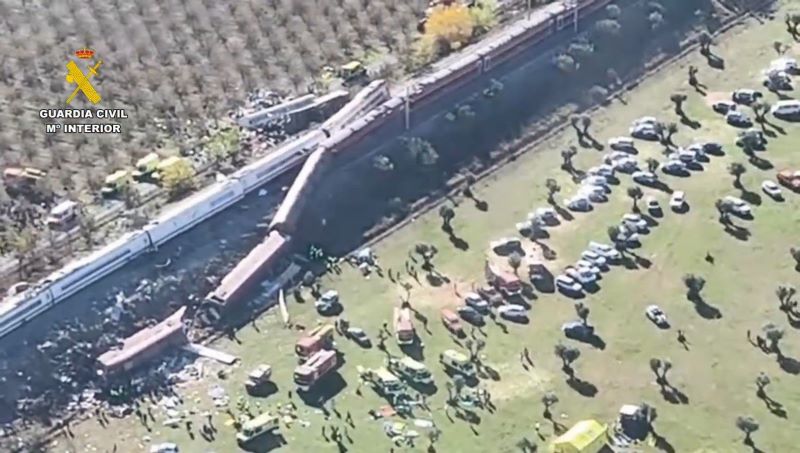
The scene was one of devastation. Several carriages remained on an elevated stretch of track, while twisted metal and broken panels lay scattered across the embankment below. At least three carriages had plunged down the slope. Ambulances, funeral vans and helicopters lined the railway as emergency crews worked through the wreckage.
Survivors described a sudden, violent impact. “We heard a massive roar, a truly enormous thud that went on for 10 seconds,” passenger Miguel told COPE radio. Another passenger, Eduarda, said she initially believed the train had made an emergency stop until she saw the injured and was ordered to evacuate. From the embankment, she saw part of a carriage hanging down the slope and a fire inside one wagon. “I saw dead people,” she told Cadena SER.
The regional government of Castilla-La Mancha said 147 people had been aboard the Iryo train and 397 on the Renfe train. Authorities did not immediately give an injury toll, but Health Minister Mónica García appealed for blood donations.
The collision came nine months after a January crash on the same line killed 46 people. A preliminary Civil Guard report pointed to possible defects in the track, rail or welds, though that investigation remains open.
The disaster is likely to intensify scrutiny of Spain’s railway spending. Although the country has invested heavily in expanding its high-speed network, only about 16 percent of average annual spending from 2018 to 2022 went to maintenance, renewal and upgrades.
With a national election due on November 29, Prime Minister Pedro Sánchez traveled to the scene and expressed solidarity with the victims and their families. The opposition People’s Party canceled campaign events.__Photo courtesy X (Spain Ministry of Interior)