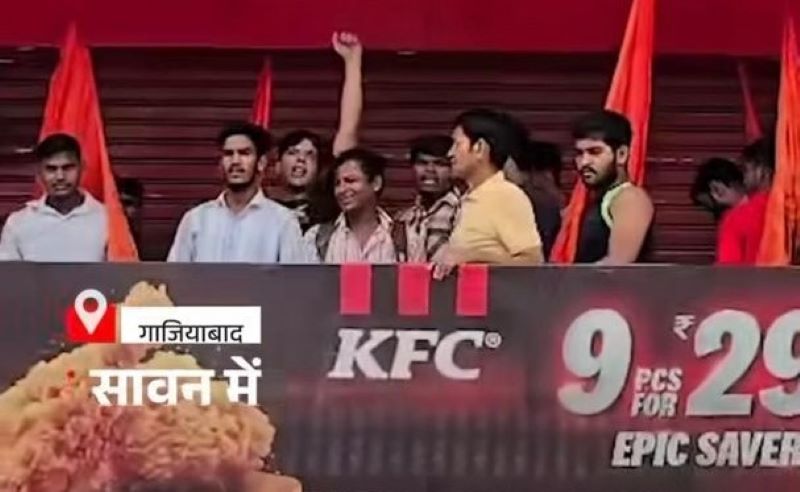
Ghaziabad, India – July 18 — In a dramatic display of religious fervor and political assertion, members of a right-wing Hindu group stormed a KFC outlet in the northern Indian city of Ghaziabad this week, forcibly shutting down the fast food chain to protest the sale of non-vegetarian food during the sacred Hindu month of Sawan, reported by Dawn News.
The incident, which unfolded amid rising religious sensitivities in parts of India, was captured in viral videos circulating across social media platforms. Protesters, clad in saffron scarves and waving flags, chanted slogans such as “Jai Shri Ram” and “Har Har Mahadev” while pulling down the outlet’s shutters.
The group, reportedly led by Pinky Chaudhary, head of the Hindu nationalist outfit Hindu Raksha Dal, demanded an immediate halt to the sale of meat during Kanwar Yatra, a religious pilgrimage observed by devotees during Sawan—a month in the Hindu lunar calendar considered sacred, during which many abstain from consuming meat, alcohol, onions, and garlic.
“Our message is clear,” Chaudhary told The Times of India. “We are asking all non-vegetarian outlets to stop selling meat during this holy period. If they want to remain open, they must serve only vegetarian food.”
The incident has sparked a broader debate across the country, drawing criticism from opposition parties and civil rights advocates who accuse the ruling Bharatiya Janata Party (BJP) of enabling religious vigilantism.
“This is a violation of citizens’ fundamental rights,” said Shahnawaz Alam, National Secretary of the Indian National Congress. “There is no official ban on meat. So how can private individuals storm a business and force it to close?”
He accused the BJP of fostering a climate where such actions are emboldened. “Holy occasions are being used to incite tension and marginalize communities,” Alam added.
The BJP has yet to respond publicly to the incident.
Legal experts warn that the lack of intervention by authorities may embolden similar groups in the future, further threatening the balance between religious practices and constitutional freedoms in the world’s largest democracy.
So far, local police have not confirmed whether any arrests or investigations are underway.
As India continues to navigate its complex intersection of faith, food, and freedom, events like these raise fresh questions about the thin line between tradition and coercion—and who gets to draw it.