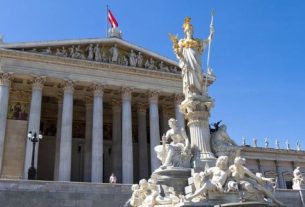
VIENNA: Austria’s right wing Freedom Party (FPÖ) plans to submit a no confidence motion against the entire federal government at the next session of parliament on October 14 and 15, as political tensions continue to rise over the country’s leadership and stalled reforms, reported by oe24.
FPÖ leader Herbert Kickl has declared the three party coalition a failed political experiment, accusing it of creating an atmosphere of stagnation at a time when Austria needs clear decisions and effective leadership. He believes the government has lost its ability to move the country forward and is increasingly focused on holding on to power rather than addressing the challenges facing the public.
Kickl directed his strongest criticism at Chancellor Christian Stocker of the conservative Austrian People’s Party (ÖVP), accusing him of allowing the political deadlock to continue because he is unwilling to give up his position.
“Stocker is cementing this unbearable standstill because he is clinging to his chancellor’s seat even more desperately than Babler is clinging to his party leadership,” Kickl said in a statement.
The FPÖ leader also claimed that the ÖVP fears a significant defeat in an early election and is therefore determined to remain in government. In his view, the coalition’s determination to stay in office has come at the expense of meaningful political progress.
The Social Democratic Party of Austria (SPÖ) also came under fire. Kickl accused the party of contributing to an unworthy political spectacle instead of focusing on constructive work. He questioned whether a party struggling with its own internal problems could effectively manage the country’s affairs.
Beyond the political dispute, Kickl pointed to economic pressures facing Austria, accusing the government of failing to respond adequately to a record number of business insolvencies and the rising cost of living. He also criticised the lack of progress on important reforms, arguing that key initiatives remain stuck while households and businesses continue to face uncertainty.
The planned no confidence motion is set to bring the coalition’s performance under renewed parliamentary scrutiny. However, announcing the motion does not automatically threaten the government’s immediate survival; its success will depend on support among members of parliament.
As the next parliamentary session approaches, Kickl is seeking to turn public frustration into political pressure, portraying the government as divided and unable to deliver the progress Austria needs.