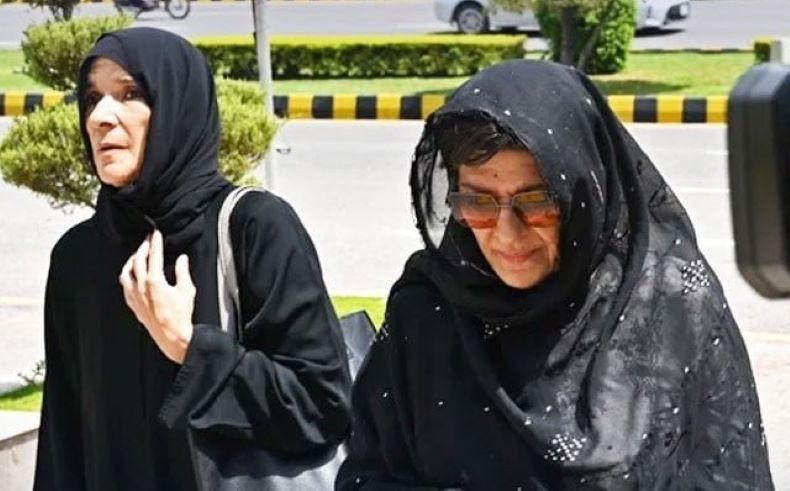
Islamabad — The political crisis in Pakistan deepened as two of Imran Khan’s sisters, Aleema Khan and Uzma Khan, were arrested during a protest in Islamabad, marking the latest escalation in the ongoing showdown between Pakistan Tehreek-e-Insaf (PTI) supporters and the government. The arrests have sparked nationwide outrage as tensions continue to rise.
Aleema Khan and Uzma Khan, along with over 100 other PTI members, were apprehended at D-Chowk during a protest that saw clashes between demonstrators and security forces. The two sisters, along with Adnan Khan—brother of PTI leader Asad Qaiser—were presented before an Anti-Terrorism Court (ATC) on Sunday. Presided over by Duty Judge Azhar Nadeem, the court ordered a one-day physical remand for the accused, despite the prosecution’s request for a 20-day remand. Charges against them include violations under Pakistan’s terrorism laws.
The arrests came as PTI staged demonstrations in defiance of the government’s crackdown on its workers. The protests follow PTI’s ongoing opposition to the government led by the Pakistan Muslim League-Nawaz (PML-N), with accusations against the government for stifling dissent and pushing for the PTI to be labeled a “terrorist organization.”
In a tragic turn of events, Islamabad police officer Hamid Shah died from injuries sustained during violent clashes between PTI supporters and law enforcement. Shah, who was attacked by demonstrators near the Chungi No. 26 area, succumbed to his injuries while receiving treatment at PIMS hospital, according to a police statement. His death has added fuel to the already volatile political atmosphere.
As the demonstrations escalated, law enforcement agencies deployed over 6,000 personnel and spent Rs54 million to secure the capital, yet PTI protesters managed to breach police cordons. Former National Assembly Speaker and PTI leader Asad Qaiser reiterated the party’s commitment to continuing the protests, declaring, “We will not back down until justice is served,” following directives from Imran Khan.
Imran Khan, the founder of PTI and Pakistan’s former prime minister, is also facing increasing legal pressure. A new case has been registered against him in Rawalpindi, with charges filed under 13 sections of the Pakistan Penal Code and Anti-Terrorism Act. The FIR alleges that Khan and his supporters incited violence, chanted slogans against state institutions, damaged public property, and interfered with government operations.
Amidst the mounting political tensions, international organizations have raised alarms. Amnesty International has called on Pakistani authorities to respect citizens’ right to peaceful assembly and to release individuals detained arbitrarily. The organization has reminded Pakistan of its obligations under the International Covenant on Civil and Political Rights (ICCPR) as the country’s human rights record comes under scrutiny ahead of an upcoming UN review.
The arrest of Khan’s family members, the death of a police officer, and the ongoing clashes between protesters and law enforcement have put significant pressure on the federal government. In a related development, the Khyber Pakhtunkhwa (K-P) Assembly passed a resolution calling for transparency, accountability, and a clearer federal stance on the province’s legal status.
As PTI vows to continue its protests and the government steps up its efforts to quell dissent, Pakistan faces an uncertain and potentially turbulent political future.