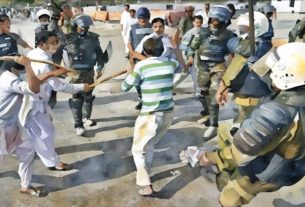
ISLAMABAD: In a landmark decision following the violent unrest of May 9, 2023, military courts in Pakistan have sentenced 25 civilians to prison terms ranging from two to 10 years, the Inter-Services Public Relations (ISPR) announced on Saturday. The convictions mark the first phase of accountability for orchestrated attacks on military installations during nationwide riots earlier this year.
The Field General Court Martial handed down 10-year rigorous imprisonment to 14 individuals, while the remaining 11 received shorter sentences. These individuals were found guilty of targeting key military sites, including Jinnah House, the General Headquarters (GHQ), and the Pakistan Air Force Base Mianwali. The ISPR underscored that these sentences followed thorough investigations and the collection of indisputable evidence.
The Events of May 9: A “Dark Chapter”
Labeling the riots as a “dark chapter” in Pakistan’s history, the military’s media wing stated that politically motivated violence on May 9 led to arson, vandalism, and attacks on national symbols. The ISPR detailed how a “sustained narrative of hate and lies” fueled the attacks on armed forces’ installations and monuments dedicated to the sacrifices of Shuhada (martyrs).
The riots, which shook the nation’s stability, were termed an attempt at “political terrorism,” aimed at imposing a distorted political agenda through violence and coercion. “These blatant acts of violence not only shocked the nation but also underscored the necessity of checking this unacceptable attempt of political terrorism,” the statement emphasized.
Legal Framework Amid Democratic Processes
The military’s prosecution of civilians in military courts has drawn scrutiny given the simultaneous functioning of Pakistan’s civil judicial system and the presence of a democratic government. Critics question the use of military trials when civilian courts remain operational, citing concerns about transparency and adherence to constitutional norms.
Nevertheless, the ISPR maintained that the trials were conducted with due legal process, highlighting the collection of “irrefutable evidence” before referring the cases to the Field General Court Martial. Legal analysts suggest these trials underscore the state’s determination to address threats to national security decisively, even as they raise broader debates about the balance between military and civilian judicial systems.
Reactions and Implications
The sentences represent what the ISPR called an “important milestone” in restoring justice and stability. They also serve as a cautionary reminder to those swayed by political propaganda to abstain from taking the law into their own hands.
While the military has deemed the verdicts a success in asserting the rule of law, human rights advocates and opposition figures have raised concerns about the broader implications of such trials on democratic governance and civil liberties. International observers are closely monitoring these developments as Pakistan navigates the aftermath of one of its most turbulent periods in recent history.
The May 9 events have left a lasting impact on the nation’s psyche, serving as a grim reminder of the dangers posed by politically charged violence. The military and civilian leadership now face the dual challenge of upholding justice while fostering unity and reconciliation in a polarized political environment.