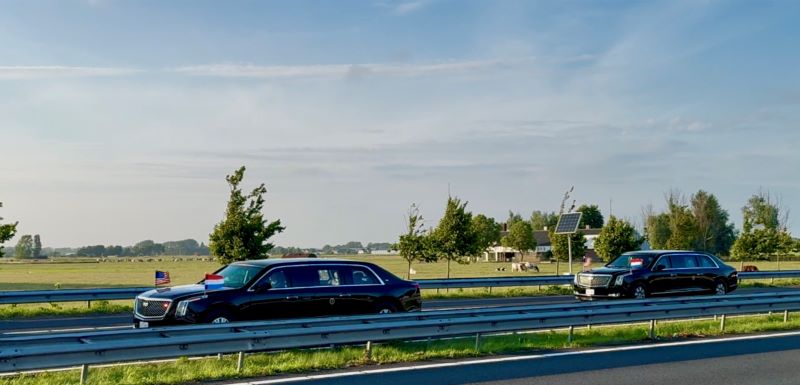
THE HAGUE — NATO leaders convened Tuesday in the Dutch capital for what German Chancellor Friedrich Merz hailed as a “historic” summit, setting a bold course for the alliance’s future amid mounting global instability and a resurgent threat from Russia.
The summit, hosted by NATO Secretary General Mark Rutte, marks former U.S. President Donald Trump’s return to the transatlantic stage — his first NATO summit since 2019 — and underscores renewed American influence over the alliance’s defense posture. All 32 NATO member states are expected to commit to spending at least 5% of their national GDP on defense and related infrastructure, a dramatic escalation from the long-standing 2% guideline.
In a gesture that surprised many, Rutte sent a flattering pre-summit message to Trump, later shared by the former president on social media. In it, Rutte credited Trump’s “decisive action in Iran” and his leadership in securing defense pledges. Brushing aside concerns over the leak, Rutte told the BBC, “There was nothing in it that had to stay secret.”
The two-day summit — scaled down in part to accommodate Trump’s schedule — opened with a royal dinner hosted by King Willem-Alexander and Queen Maxima. Wednesday’s agenda includes a brief working session expected to produce a five-paragraph communique reaffirming collective defense goals.
The focus of the summit is both ambitious and urgent: rearm a weary alliance while defending Ukraine against intensifying Russian aggression. On Tuesday, Russian missile strikes on the cities of Dnipro and Samar killed at least 17 people and injured 160 more, including 18 children. A separate strike in Sumy claimed three lives, including a child. Ukrainian President Volodymyr Zelensky, in The Hague for the summit, is set to meet Trump privately.
The 5% defense benchmark includes 3.5% for core military spending and 1.5% for defense-related areas such as cybersecurity and strategic infrastructure. Many allies, however, remain far below even the previous 2% target set in 2014. Spain and Belgium, whose current defense spending hovers near 1.3%, have signaled resistance to the new demands, with Madrid requesting an exemption — a move Rutte publicly rebuffed.
Despite grumblings from several capitals, all 32 members are expected to sign on to the pledge. German lawmakers approved a massive defense budget for 2025, increasing spending to over €62 billion, with plans to hit the 3.5% target by 2029.
Chancellor Merz emphasized that this was no favor to Washington. “We’re doing this out of conviction,” he said in Berlin. “Because Russia is actively and aggressively endangering the security and freedom of the entire Euro-Atlantic area.”
British Prime Minister Keir Starmer pledged the UK would meet the 5% goal by 2035, stating the country must navigate “this era of radical uncertainty with agility, speed, and a clear-eyed sense of national interest.”
The summit takes place against a backdrop of logistical chaos, as fire-damaged train cables near Schiphol Airport paralyzed rail traffic. Dutch Security Minister David van Weel said sabotage could not be ruled out.
As NATO embarks on its most ambitious transformation in decades, the summit in The Hague signals not just a budgetary pivot — but a stark reckoning with the geopolitical storms on its doorstep.