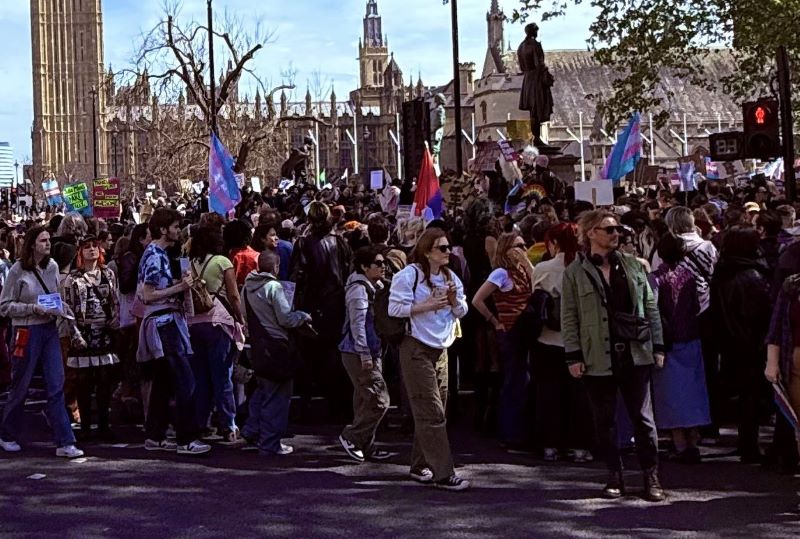
Thousands of trans rights supporters gathered in London’s Parliament Square on Saturday, raising their voices in a powerful demonstration just days after a major UK Supreme Court ruling redefined the legal meaning of “woman.”
The court’s decision, delivered on Wednesday, ruled that under the Equality Act 2010, the term “woman” refers only to someone who is biologically female. This means transgender women, even those with legal gender recognition certificates, are not considered women under the law. The ruling has sparked shock and concern across the UK’s trans community.
Holding signs that read “Trans Rights Now” and “Trans Women Are Women,” protesters waved pride flags and chanted in support of equality. Many expressed fear that this decision could mark the beginning of a wider rollback of rights.
“It’s a terrifying time,” said Sophie Gibbs, a 19-year-old transgender woman. “We’re watching our rights being taken away in front of our eyes. I thought we lived in a society that was moving forward—not backward.”
Activists warn that the ruling could limit transgender women’s access to women-only spaces like bathrooms, hospital wards, and sports teams. The head of the Equality and Human Rights Commission confirmed these exclusions may now become legal.
Zuleha Oshodi, 29, compared the situation to a Pandora’s box. “We open the door to one harmful change, and it invites more. It’s heartbreaking,” she said.
The ruling came after a Scottish law passed in 2018 required public boards to be at least 50% female. Transgender women were initially counted in that quota, but the Supreme Court overruled that interpretation.
While the court said transgender individuals are still protected from discrimination, many fear this judgment will set a dangerous precedent. Scotland’s First Minister John Swinney said he understands the “hurt and anguish” the trans community is feeling, though the law must be upheld.
In the most recent census, around 116,000 people in Great Britain identified as transgender, with roughly 8,500 having legal recognition of their gender.