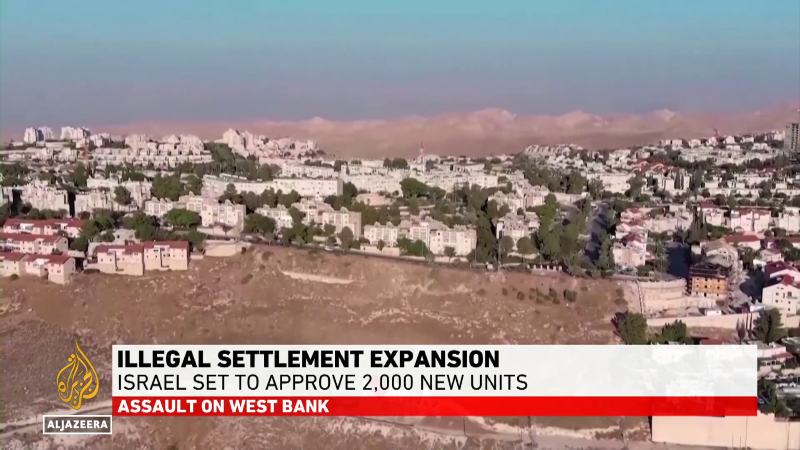
JERUSALEM — In a move that Palestinian officials are calling the death knell for a two-state solution, Israel is preparing to advance sweeping settlement plans in occupied East Jerusalem that would fundamentally reshape the political geography of the region, according to Al Jazeera News.
Israeli authorities are set to discuss approval for 9,000 housing units on the grounds of the defunct Qalandiya airport, known locally as Atarot, along with a separate project in the Sheikh Jarrah neighborhood that would displace 40 Palestinian families. The Jerusalem governorate announced the plans on Sunday, triggering immediate alarm among those who see the proposals as a strategic stranglehold on Palestinian aspirations.
Suhail Khalilieh, a political analyst specializing in Israeli settlement policy, told Al Jazeera the timing is no coincidence. The Atarot plan, briefly shelved last December, has returned to the agenda following recent meetings between Israeli Prime Minister Benjamin Netanyahu and U.S. President Donald Trump.
“The meeting served as a green light for continued settlement expansion,” Khalilieh said, noting that the American position treating Jerusalem as beyond negotiation has emboldened Israeli plans. International criticism, he added, has been reduced to “verbal objections without any deterrence.”
The airport project represents far more than new housing. According to Khalilieh, it forms one pillar of a three-pronged strategy to realize the vision of “Greater Jerusalem”, a dramatically expanded Israeli municipal boundary that would consume significant portions of the West Bank.
To the north, Atarot would link East Jerusalem with the Givat Zeev settlement bloc, severing connections to Ramallah. Eastward, the E1 plan aims to bridge the city with Maale Adumim. Southward, expansions would connect to Gush Etzion. Together, these moves would increase Jerusalem’s footprint by 175 square kilometers expanding Israeli control to 246 square kilometers, or 4.5 percent of the entire West Bank.
“This aims to abort any possibility of establishing a Palestinian capital in East Jerusalem,” Khalilieh warned.
Meanwhile, the Sheikh Jarrah plan targets the “Holy Basin” area north of the Old City, part of what Khalilieh described as efforts to create a settlement ring that would isolate Palestinian neighborhoods like Silwan, the Mount of Olives, and Sheikh Jarrah into disconnected population pockets.
The strategy, he argued, operates under sanitized language terms like “urban renewal” and “land settlement” masking what amounts to forced displacement. More than 300 Palestinian homes were demolished in East Jerusalem in 2025 alone, often under the pretext of lacking permits that are virtually impossible for Palestinians to obtain.
Khalilieh emphasized that intervention must come before construction begins, as reversing physical facts on the ground becomes politically impossible. He called for activating provisional measures at the International Court of Justice and targeting international companies involved in the projects.
“The problem is a political dilemma, not a legal one,” he concluded. “Early intervention is crucial to freeze these projects before it’s too late.”__Photo Courtesy Screengrab Al Jazeera News