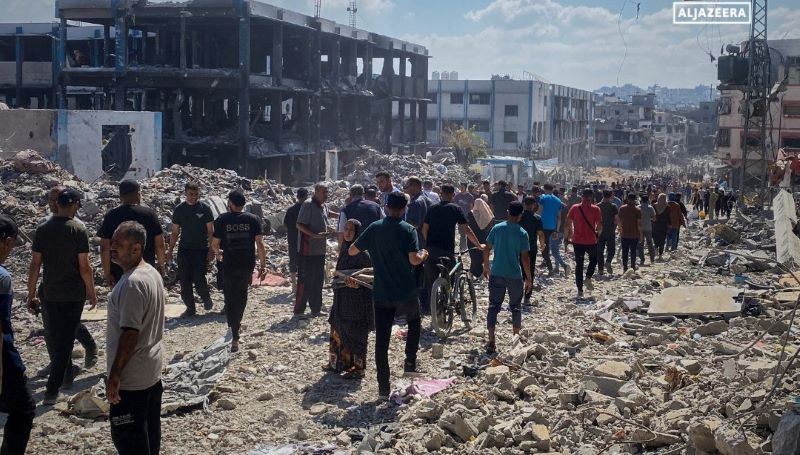
GAZA CITY, Palestinian Territories — The people of Gaza City returned this weekend to a landscape of ruin and silence. Streets once filled with life now lie buried beneath mountains of shattered concrete and twisted steel, a grim reminder of two years of war. Amid the desolation, the air is heavy with uncertainty and the faintest stirrings of hope.
Hundreds of thousands of Palestinians streamed back into the city on Saturday after the latest ceasefire between Israel and Hamas. The truce, part of a U.S.-brokered peace initiative led by President Donald Trump, promises an exchange of hostages and prisoners and, eventually, a new political order in Gaza.
Standing before a crowd in Tel Aviv, U.S. peace envoy Steve Witkoff declared, “To the hostages themselves: you are coming home.” His words drew chants of “Thank you, Trump” from Israelis still grieving the Hamas attacks of October 7, 2023, which killed more than 1,200 people and ignited the devastating conflict that followed.
Under the plan, Israel is to release 250 Palestinian prisoners, including some serving life sentences, along with 1,700 Gazans detained since the war began. In return, Hamas must hand over 47 remaining Israeli hostages, living and dead by Monday. The remains of one Israeli held since 2014 are also expected to be returned.
But the peace that so many crave remains fragile. From exile in Qatar, senior Hamas official Hossam Badran warned that the next phase of negotiations “contains many complexities and difficulties.” Hamas has rejected calls to disarm, calling it “out of the question.” Iran, the group’s key ally, voiced skepticism, accusing Israel of repeatedly violating past ceasefires.
The Trump plan envisions Israel’s gradual withdrawal from Gaza’s cities, to be replaced by a multinational peacekeeping force led by Egypt, Qatar, Turkey, and the United Arab Emirates under U.S. coordination. On Saturday, U.S. Central Command chief Admiral Brad Cooper toured Gaza with Witkoff and Jared Kushner, before Kushner and Ivanka Trump joined hostage families in Tel Aviv.
As politics played out in capitals, Gazans picked through the debris of their lives.
“We walked for hours, afraid of what we’d find,” said Raja Salmi, 52, standing where her home once stood in the Al-Rimal neighborhood. “I stood before it and cried. All those memories are now dust.”
Drone footage showed entire blocks flattened, apartment buildings ripped open, their contents spilling into streets coated in ash. Yet amid the wreckage, signs of resilience flickered. “Thank God, our home is still standing,” said Sami Musa, 28. “But it felt like a ghost town. The smell of death still lingers.”
Gaza’s health ministry reports more than 67,000 Palestinians killed since 2023, over half of them women and children; figures the United Nations calls credible. The war’s cost has been almost beyond counting. Whether the coming peace can bear that weight remains to be seen.