As election campaigns intensify across Gilgit-Baltistan ahead of the June 7 polls, Pakistan’s major political parties have once again descended upon the mountainous region with promises of development, prosperity, and political empowerment. Yet for many residents, the campaign speeches sound strikingly familiar.
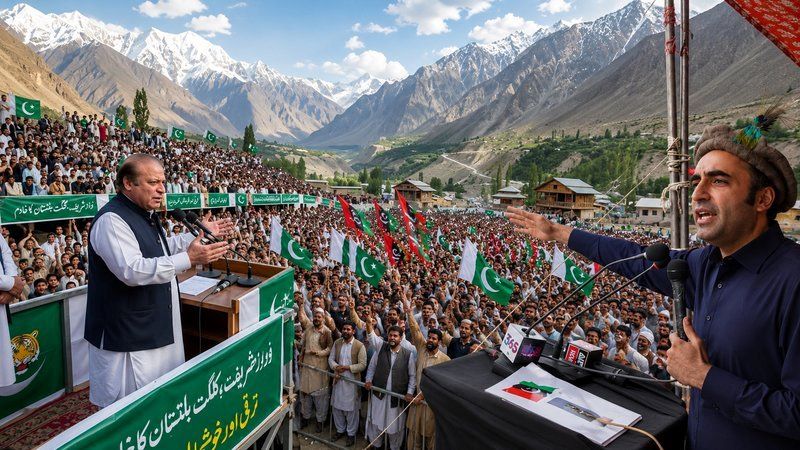
Former Prime Minister Nawaz Sharif and Pakistan Peoples Party Chairman Bilawal Bhutto Zardari have both addressed large public gatherings in Gilgit and Skardu, pledging to resolve long standing issues facing the region. Their speeches focused on infrastructure, economic development, social welfare, and regional progress. However, many local residents and political observers argue that similar commitments have been made repeatedly over the decades, with little visible transformation in everyday life.
Gilgit-Baltistan, a strategically important region of the wider Kashmir territory, has witnessed successive governments backed by Pakistan’s leading political parties since the late 1940s. Despite periodic promises of constitutional rights, modern infrastructure, employment opportunities, improved healthcare, and quality education, many communities continue to struggle with inadequate roads, limited public services, power shortages, and economic hardship.
During his rally, Nawaz Sharif criticized the poor condition of infrastructure and questioned why development funds had not translated into meaningful improvements for the people. Bilawal Bhutto, meanwhile, pledged that a strong mandate for his party would enable it to address the region’s challenges and expand social welfare programs.
Yet critics note that leaders from both parties have previously held power either at the federal level or within Gilgit-Baltistan’s governing structures. They argue that the region’s fundamental problems have remained largely unchanged regardless of which political party formed the government.
Many residents acknowledge that the China-Pakistan Economic Corridor (CPEC), supported and financed by China, has brought some visible infrastructure improvements and enhanced regional connectivity. Beyond those projects, however, many locals say the pace of development has fallen far short of expectations.
A growing sense of political fatigue can be felt across parts of Gilgit-Baltistan. Residents increasingly question whether election promises will be followed by practical action once votes are counted. Some local activists and independent observers also raise concerns about electoral transparency, alleging that political manipulation and administrative influence have affected previous electoral processes. Such allegations remain a subject of political debate and are frequently rejected by state authorities.
As candidates compete for votes across the region’s 24 constituencies, the central question facing many voters is no longer what politicians promise during campaigns. Instead, it is whether any government, regardless of party affiliation, can finally deliver meaningful change to a population that has waited for decades to see its aspirations reflected in reality.
For many people in Gilgit-Baltistan, this election is not simply another political contest. It is a test of trust, accountability, and whether the region’s long standing grievances will continue to echo through another generation.