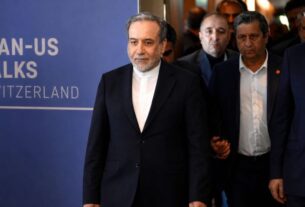
Tensions in the Middle East sharply escalated over the weekend as the United States and Iran exchanged fresh military strikes, raising fears that a fragile ceasefire could collapse and further disrupt global energy routes, according to Dawn News.
Iran’s Foreign Minister Abbas Araghchi warned that any attempt to bypass agreed shipping routes in the Strait of Hormuz would only deepen the crisis. Speaking in Baghdad on Sunday, he said such moves would “increase tensions” and delay efforts to fully reopen one of the world’s most critical oil corridors.
His remarks came hours after the US military carried out new strikes on multiple targets inside Iran. Washington said the attacks were a response to an Iranian drone strike on an oil tanker, the Kiku, which was passing through the Strait and carrying around two million barrels of crude.
In response, Iran launched retaliatory strikes on US military facilities in Bahrain and Kuwait. Iranian state media reported explosions in southern Iran following US attacks, while the Islamic Revolutionary Guard Corps (IRGC) warned that further violations would trigger even stronger responses.
The exchange marks the latest blow to a ceasefire agreement reached on June 18 through Pakistan’s mediation. The deal had aimed to calm a conflict that began on February 28, when the United States and Israel launched military operations that disrupted shipping in the Strait of Hormuz and unsettled global energy markets.
Under the agreement, Iran had allowed safe passage for commercial vessels for a limited period. However, tensions have continued to rise over competing shipping routes. Tehran insists that vessels must follow a corridor along its coastline, while alternative routes have reportedly been used without its approval.
Iran has warned that it will take firmer control of maritime traffic in the Strait, a move that could further complicate international shipping. Nearly a fifth of the world’s oil supply passes through this narrow waterway, making any disruption a matter of global concern.
Both sides have accused each other of breaking the ceasefire. The IRGC said US strikes violated the agreement and threatened to halt all diplomatic efforts. It also claimed to have targeted key US military sites in the region, though US officials said there were no casualties and limited damage.
In Bahrain, air raid sirens sounded, and a residential building was reportedly damaged, though no injuries were confirmed. Kuwait said it intercepted ballistic missiles aimed at its territory.
Meanwhile, US President Donald Trump issued a stark warning, saying Iran could face destruction if the conflict escalates further. His comments added to the sense of uncertainty surrounding the already fragile truce.
As military actions continue and diplomatic trust erodes, the Strait of Hormuz once again stands at the center of a widening crisis—one where each strike risks pulling the region further from peace.