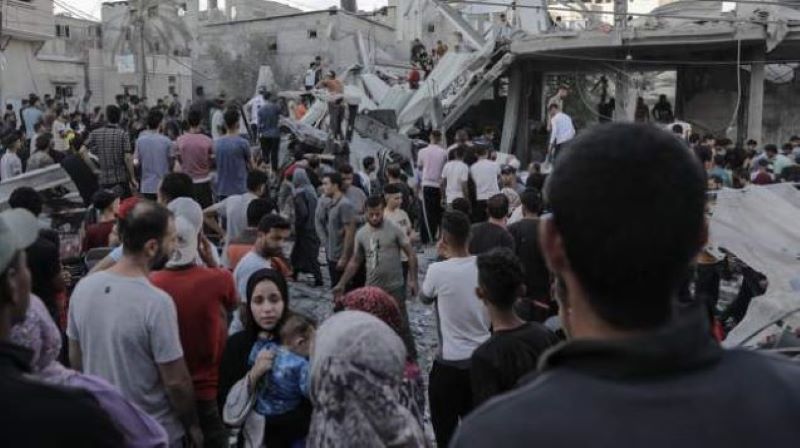
NEW YORK CITY — Once considered the last safe refuge, Gaza City has become what a senior UNICEF official describes as “a city of fear, flight, and funerals,” where childhood itself cannot survive, reported by Arab News.
Speaking Thursday after nine days inside the besieged enclave, Tess Ingram, UNICEF’s communications manager for the Middle East and North Africa, warned that catastrophe has already arrived for nearly one million people trapped in Gaza City.
“The unthinkable is not looming — it is already here,” she said.
Ingram recounted scenes of desperation: children separated from parents in chaotic evacuations, mothers mourning infants lost to starvation, and hospital wards crowded with youngsters mutilated by shrapnel. Among the most haunting stories was that of Nesma, a mother who watched her malnourished son Jouri die last month. Her daughter Jana, once evacuated for treatment and briefly recovered, is again critically ill. “I am crushed after raising my child only to lose him in my arms,” Nesma told Ingram. “I beg not to lose Jana too.”
UNICEF warns that Gaza is now gripped by famine-like conditions. Of 92 nutrition centers the agency supports, fewer than half remain open. Clinics that survive are overwhelmed by skeletal children and parents who whisper that a single bowl of lentils or rice must feed an entire family each day. Mothers often skip meals altogether so their children can eat.
The numbers tell a devastating story. In February, 2,000 children were admitted for treatment of hunger. By July, that figure soared to 13,000. In just the first half of August, another 7,200 were admitted.
Despite the scale of suffering, aid deliveries remain strangled. An average of only 41 trucks a day are allowed into Gaza — a fraction of the 6,000 to 8,500 humanitarian convoys required. Even on the best days, no more than 100 trucks cross. Bureaucratic delays, security checks, and looting further scatter supplies before they reach desperate families.
UNICEF says its Gaza response requires $716 million, but less than 40 percent of that funding has materialized. Nutritional aid, despite famine conditions, is only 17 percent funded. “We could do far more and reach every child if our operations were enabled at scale and fully funded,” Ingram stressed.
Even basic survival is precarious. Eleven hospitals in Gaza City remain partially functional, only five of them equipped with neonatal intensive care. Forty incubators, stretched to double capacity, are struggling to keep 80 fragile newborns alive as power supplies flicker.
Even areas designated as “safe zones” offer little security. Ingram met Mona, a 13-year-old girl who lost her mother, 2-year-old brother, and 8-year-old sister in an Israeli strike. She now lies in a hospital bed after abdominal surgery and the amputation of her left leg. “It hurt a lot,” she said quietly. “But I’m not sad about my leg; I’m sad that I lost my mum.”
Ingram urged Israeli authorities to revise rules of engagement to better protect children, and called on Hamas and other armed groups to release hostages. Above all, she appealed for a renewed ceasefire and unimpeded humanitarian access.
“Palestinian life is being dismantled,” Ingram warned. “The cost of inaction will be measured in the lives of children buried in rubble, wasted by hunger, and silenced before they ever had a chance to speak.”