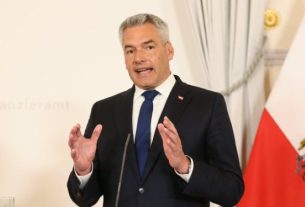
Gerald Fleischmann — the spokesperson for two former Austrian leaders — warns that democracy is at risk from online influencers covertly spreading disinformation.
Gerald Fleischmann, former spokesperson of Austrian chancellors Sebastian Kurz and Karl Nehammer, has published a new book, Codes of Extremists, that explores disinformation and the impact of extremism on Europe’s stability.
The communications manager has worked for the Austrian People’s Party (ÖVP) since 2007 — becoming a key advisor and the lead spokesperson for chancellors Kurz and Nehammer.
His new book explores the techniques and rhetoric of extremists across the political spectrum to understand how extreme ideologies threaten European democracy.
In an interview with Euronews, Fleischmann discussed how Germany and Austria could strengthen democracy, the danger of online influencers in spreading extreme ideas and what left-wing and right-wing extremists have in common with Islamists.
Gerald Fleischmann: First of all, I think it’s important to continue the effort that this book undertakes — to bring transparency, educate people, and highlight that many of these influencers are actually members or so-called “voting agents” working for foreign forces.
At the same time, I believe it is crucial to strengthen traditional media in Austria, Germany, Switzerland, and across Europe. So far, traditional media has played an essential role in upholding democracy by creating a shared public space with common rules and a form of collective identity.
With the decline of traditional media — partly driven by these radical groups — this shared public space is being lost. Keywords here are “echo chambers” and “filter bubbles.”
Young people are becoming detached from traditional media, and many no longer consume it at all. There are two key issues here. Firstly, it is striking that all social media platforms originate from America, Russia, or Asia (such as China), but not a single one comes from Europe.
This is a political issue. Secondly, traditional media faces the challenge of transitioning into modern, digital formats — social media with video-based content. This is known as “social journalism.”
Friday, July 17, 2026