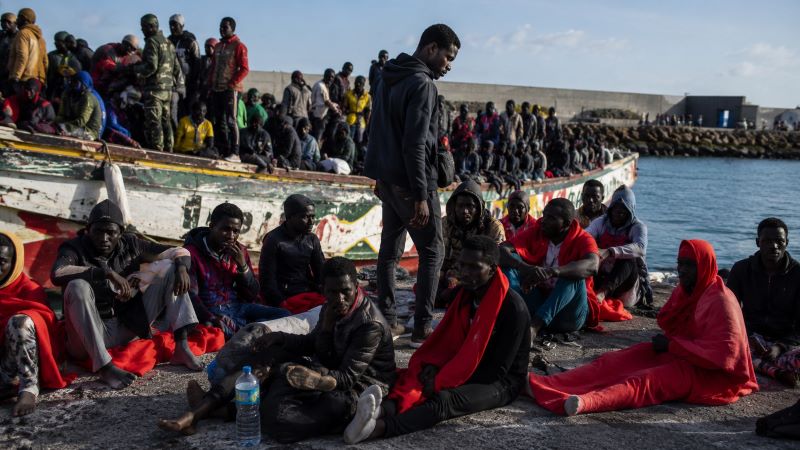
Spain has declared a migration emergency in the Canary Islands after more than 9,000 people reached the Atlantic territory since the beginning of November. The surge has pushed the islands’ reception system to its limits and renewed attention on one of Europe’s deadliest migration routes, according to Al Jazeera News.
On Saturday alone, Spain’s Maritime Rescue Service rescued 1,488 migrants from 14 overcrowded dinghies, or pirogues, most of which arrived on El Hierro after leaving West Africa. The figure surpassed the previous single-day record of 1,461 people, set in November 2020.
Spain’s Territorial Policy Minister, Angel Victor Torres, travelled to El Hierro on Sunday to assess the situation. New arrivals are processed at the island’s port before being taken to reception centres and transferred to other Canary Islands or mainland Spain.
Al Jazeera correspondent Bernard Smith said this year’s arrivals have set a record since statistics began being collected 32 years ago. He noted that the numbers continued to rise even by Sunday afternoon.
Most migrants begin their journey in West Africa, particularly Senegal, hoping to reach mainland Europe. Many travel in small wooden fishing boats that are dangerously overcrowded. One vessel arriving on Saturday carried 240 people, including 12 women and 36 children.
The journey can last up to a week and remains extremely dangerous. The International Organization for Migration recorded at least 450 deaths on the Western African Atlantic route during the first 10 months of 2026.
Favourable weather has made departures from African coastlines easier in recent years, but it has not made the crossing safe. Migrants often spend days at sea in vessels carrying as many as 100 people, exposed to rough waters, exhaustion and the constant risk of capsizing.
The crisis comes as the European Union’s new Pact on Migration and Asylum came into force on June 12, 2026. The agreement introduces stricter and more coordinated rules for handling asylum claims, but it has not stopped people from attempting the crossing.
Spain is also under pressure at its North African enclave of Ceuta, where tens of thousands entered from Morocco during a 48-hour period in late July. At least 100 people died during that mass crossing.
For now, El Hierro remains at the centre of a humanitarian emergency, as rescue teams continue to bring exhausted migrants ashore.