BRICS Declaration; What It Says, and What It Doesn’t
This weekend, some of the world’s most powerful leaders gathered in Delhi around a vast circular table, summoned by Indian Prime Minister Narendra Modi’s call to become “rule shapers, not rule takers”. Among them were Chinese President Xi Jinping, Russian President Vladimir Putin, Iran’s President Masoud Pezeshkian, Abu Dhabi’s Crown Prince Sheikh Khaled bin Mohamed bin Zayed Al Nahyan, and South African President Cyril Ramaphosa.
These are hardly natural allies. India and China clashed along their disputed border in 2020. Iran and the UAE have stood on opposing sides of the Middle East war, with Tehran even launching missiles and drones at its fellow BRICS member. That India managed to bring them together in person is a diplomatic feat in itself, as reported by BBC News.
Yet beneath the show of unity ran a deeper tension. For China, Russia, and Iran, BRICS is a vehicle to dilute Western influence. India, however, has been reluctant to cast the group as an anti-Western bloc. Modi insisted the grouping is “not against anyone”, a distinction that matters for Delhi as it seeks to preserve relationships with nations often at odds with each other.
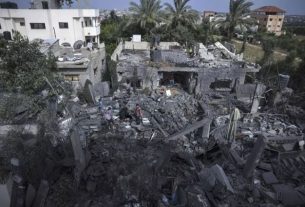
The summit did deliver a joint declaration, a notable achievement after two earlier ministerial meetings failed to produce one. But the “New Delhi Declaration” is striking for what it does not say. On the Middle East war, it urges “maximum restraint” and condemns attacks on civilian infrastructure, yet assigns no blame. It reaffirms support for a two-state solution but avoids naming any party. There is no mention at all of Russia’s war in Ukraine, a departure from previous BRICS statements.
On trade, the declaration expresses concern over “indiscriminate rising tariffs” and condemns unilateral sanctions, but stops short of naming the United States. Several members were keen to avoid provoking President Donald Trump, who has previously branded some BRICS proposals, including digital currency linkages, as “anti-American”.
Beyond the text, the summit offered rare diplomatic openings. Iran’s Pezeshkian and Abu Dhabi’s crown prince held their highest-level face-to-face talks since the war began, a sign that BRICS can create space for rivals to meet outside Western dominated institutions. For Tehran, the gathering was a chance to show it does not stand alone amid US sanctions and military pressure.
China–India relations also took a cautious step forward. Xi’s first visit to Delhi in seven years featured a cordial handshake with Modi, though he stayed less than 24 hours and skipped the gala dinner. The two leaders agreed to strengthen business ties and address trade barriers, but deep mistrust and a large trade imbalance remain.
The harder question is what comes next. Members agree they need a new global order more than ever, but what should replace the old one and how to get there remains far more challenging to answer.