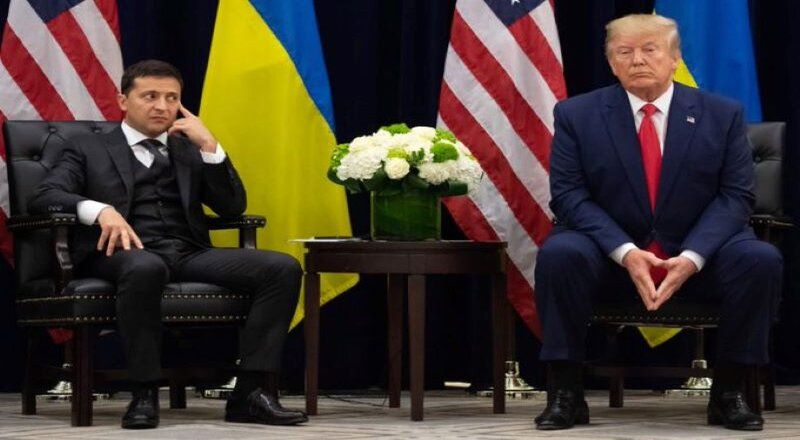
Ukrainian President Volodymyr Zelensky departed Washington on Friday without the long-range Tomahawk missiles his government had hoped to secure from the United States, after a meeting with President Donald Trump that mixed cordial diplomacy with calculated restraint.
The two leaders met at the White House to discuss Ukraine’s defense needs and prospects for peace. While Zelensky confirmed that long-range missiles were part of the discussion, both sides agreed to stay quiet on details. “The United States does not want an escalation,” Zelensky said afterward, signaling that the talks were more about tone than terms.
Trump, speaking later to reporters, described the weapons as “a big deal” and said the U.S. must prioritize its own defense. “Hopefully we’ll get the war over without thinking about Tomahawks,” he said, expressing optimism that peace could be “fairly close.”
The meeting followed Trump’s phone call a day earlier with Russian President Vladimir Putin, after which the two agreed to meet soon in Hungary. Trump described that call as “very productive,” saying both sides made “great progress.”
The timing of the two conversations—Putin one day, Zelensky the next—underscored Trump’s bid to cast himself as a dealmaker capable of ending the war. Yet his refusal to approve missile transfers left Kyiv wary of what peace might mean on American terms.
Zelensky had argued that the Tomahawk missiles could cripple Russia’s oil and energy infrastructure, striking at the heart of President Putin’s war economy. Putin, for his part, warned that such a move would seriously damage relations with Washington.
Asked whether he thought Putin’s upcoming meeting with Trump was a genuine effort toward peace or merely a stall tactic, Zelensky replied, “I don’t know,” adding that Russia was “afraid because [the Tomahawk] is a strong weapon.”
When pressed on whether he was optimistic about eventually obtaining the missiles, he offered a characteristically sober response: “I am realistic.”
Trump, meanwhile, reiterated his belief that the fighting should stop “where they are”—along the current front line. Surprisingly, Zelensky seemed open to that notion. “We have to stop where we are. He is right, the president is right,” he said, though he added that “the step after that would be to speak.”
After leaving the White House, Zelensky called European leaders to brief them on the talks. In a message on X, he emphasized that Ukraine’s priority was “to protect as many lives as possible, guarantee security for Ukraine, and strengthen all of us in Europe.”
British Prime Minister Keir Starmer later described his call with Zelensky as “productive,” pledging continued humanitarian and military support.
In Kyiv, the news landed with mixed feelings. “We appreciate all support,” said Volodymyr, a small shop owner rebuilding his store after a Russian missile strike. He paused as tears welled up, then added softly, “Truth and democracy will win. We just want to live. We don’t want to give up. We just want them to leave us alone.”