From Vienna to Tirana; A Generation’s Cry for a Livable Future
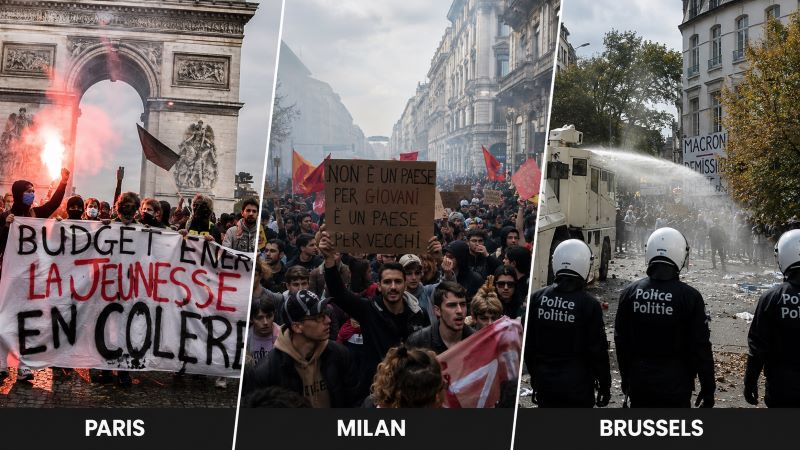
Across Europe, young people are taking to the streets in a wave of protests that has sometimes turned violent. Their demands vary from country to country, but the message is strikingly similar: a generation feels shut out of an affordable, independent future.
Austria has remained comparatively calm. In Vienna, thousands of students recently demonstrated for a larger university budget, while two Halloween protests stayed peaceful until nightfall, when riots broke out. In Germany, the movement “Gen Z regelt” mobilised young people in more than 30 cities. After largely peaceful demonstrations, violence flared in Frankfurt and Cologne; Basel and Zurich in Switzerland also saw unrest.
The protests reflect a tangle of anxieties: overcrowded schools, scarce housing, insecure work, war and the rising cost of living. Yet beneath the local issues lies one shared pressure—the sense that energy prices, inflation and strained public budgets have made ordinary life increasingly difficult for the young.
France has become the most combustible example. What began as anger over crowded classrooms, underfunded schools and unequal opportunity spread from Paris to cities across the country. An Austrian businessman who spends time in France described the atmosphere to APA as a “pressure cooker.” In Marseille, he said, aggressive driving and public confrontations revealed a society on edge. Even in Clermont-Ferrand, a student protest outside a lycée escalated within minutes, with masked demonstrators preparing Molotov cocktails and projectiles. He also noticed a stronger police and military presence nationwide.
France’s unrest is inseparable from its political and financial troubles. Fitch recently lowered its outlook on the country’s credit rating to “negative,” citing weaker growth, a worsening budget position and difficulty controlling debt. Palestinian flags at the demonstrations added another layer, expressing solidarity with Gaza, opposition to war and criticism of rising military spending.
In Italy, the central struggle is economic independence. Young Italians often find it hard to leave home, and even a strong education does not ensure stable employment. Students in Rome, Milan, Bologna, Turin and Florence protested over high rents, living costs and the shortage of student housing, though violence remained limited compared with France.
Housing is also the burning issue on the Iberian Peninsula. In Lisbon, police removed a protest camp against a crisis that has seen Portuguese property prices more than double in under a decade. In Spain, youth unemployment and soaring rents brought tens of thousands onto the streets after the eviction and death of 87-year-old Maricarmen Abascal. Her case helped push Prime Minister Pedro Sánchez to call a snap election for 29 November. Spain’s central bank estimates a national housing shortfall of about 750,000 homes.
In the Balkans, economic frustration merges with anger at corruption and weak institutions. In Serbia, student protests after the deadly Novi Sad railway-station collapse grew into a political movement that defeated Aleksandar Vučić’s ruling party. In Albania, the “Flamingo Revolution” has united young people against education problems, government misconduct and a luxury coastal development linked to Jared Kushner.
From Lisbon to Tirana, the protests may have different sparks, but they reveal the same anxiety: for many young Europeans, adulthood no longer feels within reach.