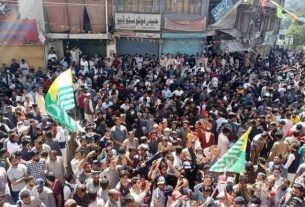
British Kashmiris Intensify International Campaign as Months-Long JAAC Protest Deepens Security Crisis in AJK
MUZAFFARABAD / LONDON / GENEVA – The Kashmir dispute is entering a new political phase as British Kashmiri activists increasingly present their case directly before international institutions, while authorities in Azad Jammu and Kashmir (AJK) struggle to contain months-long protests led by the Jammu Kashmir Joint Awami Action Committee (JAAC).
Unlike previous decades, when the Kashmir issue was largely represented by the governments of Pakistan and India, many members of the Kashmiri diaspora now say they are taking their own case to international forums, arguing that the future of Jammu and Kashmir should ultimately be decided by its people.
Diaspora Pushes Kashmir Case at International Forums
Kashmiri organizations based in the United Kingdom say they have submitted petitions, testimonies and legal documents to the United Nations Human Rights Council and other international bodies. Their arguments frequently refer to the United Nations Commission for India and Pakistan (UNCIP) Resolution of 5 January 1949, which envisioned that the state’s future would be determined through a free and impartial plebiscite under UN supervision.
The activists argue that this commitment remains valid because the relevant UN Security Council resolutions have never been formally repealed.
They further maintain that:
the people of Kashmir were not parties to the 1972 Shimla Agreement between India and Pakistan;
therefore, they argue, the agreement cannot extinguish what they consider the Kashmiri people’s right to self-determination;
they also contend that the UN commitment was made to the people of Jammu and Kashmir rather than to governments alone.
These arguments represent the position of the campaigners and remain disputed by India.
Pakistan Reaffirms Support
Pakistan continues to support the principle of self-determination for Kashmiris.
On 5 January 2021, Pakistan’s Permanent Representative to the United Nations, Munir Akram, stated that self-determination is a fundamental principle of the UN Charter and that the people of Jammu and Kashmir have the right to determine their own future.
India, however, maintains that Jammu and Kashmir is an integral part of the country and argues that the matter should be addressed bilaterally under the Shimla Agreement.
Debate Reaches British Parliament
Supporters of the Kashmiri cause also point to discussions in the UK Parliament, including an Early Day Motion (EDM) expressing support for earlier UN resolutions concerning Kashmir.
Although Early Day Motions rarely become law or government policy, campaigners regard them as evidence that the issue continues to receive political attention within the United Kingdom.
A Shift in International Advocacy
Observers note that one significant change over recent years has been the growing role of the Kashmiri diaspora.
Rather than relying solely on Islamabad or New Delhi to represent their interests, many overseas Kashmiris are lobbying lawmakers, human rights organizations and international institutions directly.
Supporters believe this has gradually shifted parts of the international discussion from a purely India-Pakistan territorial dispute toward questions of human rights, civil liberties and political representation.
Former Police Chief Defends Kashmiri Identity
During a recent gathering focused on the future of Azad Jammu and Kashmir, former Inspector General of Police Faheem Abbasi defended the patriotism of Kashmiris.
In an emotional speech, he criticized those who question the loyalty of Kashmiris toward Pakistan.
“Our ancestors are buried in Srinagar,” he said, adding that generations of Kashmiris had made sacrifices for Pakistan and should not feel compelled to repeatedly prove their commitment.
His remarks received considerable attention on social media, where supporters praised his comments while others offered differing political views.
AJK Government Seeks Reinforcements as Security Situation Worsens
Meanwhile, an official letter issued by the AJK Home Department, dated 8 July 2026, reveals growing concern within the administration over the deteriorating law-and-order situation.
Addressed to Pakistan’s Ministry of Interior, the document requests:
4,000 personnel from the Federal Constabulary
Seven wings of Pakistan Rangers
to assist local authorities.
According to the letter, officials accuse the banned Jammu Kashmir Joint Awami Action Committee (JAAC) of organizing prolonged protests, long marches and demonstrations that they say have disrupted public life and challenged state authority.
The government further alleges that:
four police personnel have been killed;
174 officers have been injured;
armed individuals associated with the banned organization have attempted to destabilize parts of Muzaffarabad and Mirpur divisions;
trucks transporting essential food supplies have been attacked and burned.
The document also requests that half of the incoming personnel be equipped with conventional weapons and ammunition, while the remaining half receive anti-riot equipment for crowd-control operations.
JAAC Rejects Government Allegations
JAAC has consistently presented itself as a public movement advocating affordable electricity, reduced taxation and constitutional rights for the people of AJK.
The organization has disputed many government allegations and maintains that its campaign is rooted in peaceful public demands. Independent verification of all claims made by either side remains limited.
A Region at a Sensitive Turning Point
The simultaneous rise of international advocacy by British Kashmiris and prolonged political unrest inside AJK illustrates the increasingly complex nature of the Kashmir issue.
While diplomatic efforts continue in international forums, tensions on the ground have exposed growing divisions between protest movements and state authorities.
Whether these developments reshape international engagement with Kashmir remains uncertain, but they demonstrate that the conversation is no longer confined to governments alone. Civil society, diaspora communities and local political movements are becoming increasingly visible participants in one of South Asia’s longest-running disputes.