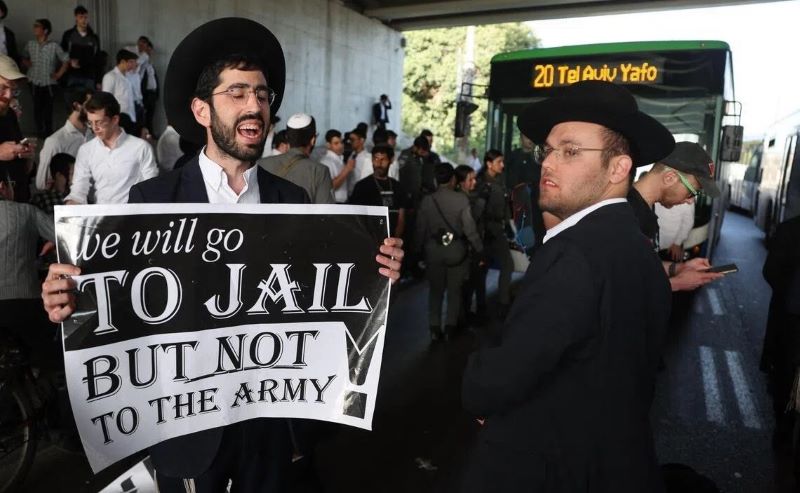
Late Tuesday night, tensions over Israel’s military draft erupted into a dramatic scene in the southern city of Ashkelon, where ultra-Orthodox protesters forced their way into the home of a senior military police officer, according to Anadolu.
According to Israeli Army Radio, dozens of Haredi men broke into the yard of Brig. Gen. Yuval Yamin, head of the military police, protesting recent arrests of ultra-Orthodox men accused of avoiding mandatory military service. Around 200 demonstrators had gathered outside the house, police said, but some escalated the protest by climbing over the fence and entering the property.
Yamin was not home at the time, but his wife and children were inside, raising alarm among officials. Despite having prior information about the protest, police were unable to prevent the breach.
Israeli leaders quickly condemned the incident. Prime Minister Benjamin Netanyahu called for firm action against those responsible, while Defence Minister Israel Katz described the break-in as a deliberate and serious attack, especially given that the officer’s family was present.
The unrest was not limited to Ashkelon. In Jerusalem, hundreds of ultra-Orthodox protesters blocked roads and clashed with police at the Golda Meir Junction. Earlier in the evening, demonstrators shut down Highway 4 near Bnei Brak, chanting, “We will die and not enlist,” and holding banners opposing secular life.
The protests follow the army’s renewed effort to arrest draft evaders after a pause during the recent war with Iran. Police said some of the demonstrations were illegal, and at least two people were arrested.
At the heart of the conflict is a long-standing dispute over military service. Israel’s Supreme Court ruled in June 2024 that ultra-Orthodox men must be drafted and ordered the government to stop funding religious schools whose students refuse to serve.
Ultra-Orthodox Jews make up about 13 percent of Israel’s population. For decades, many have been exempt from military duty, arguing that religious study is their primary obligation. But as Israel faces ongoing conflict and rising casualties, pressure has grown from other parts of society demanding that all citizens share the burden.__Photo Courtesy X