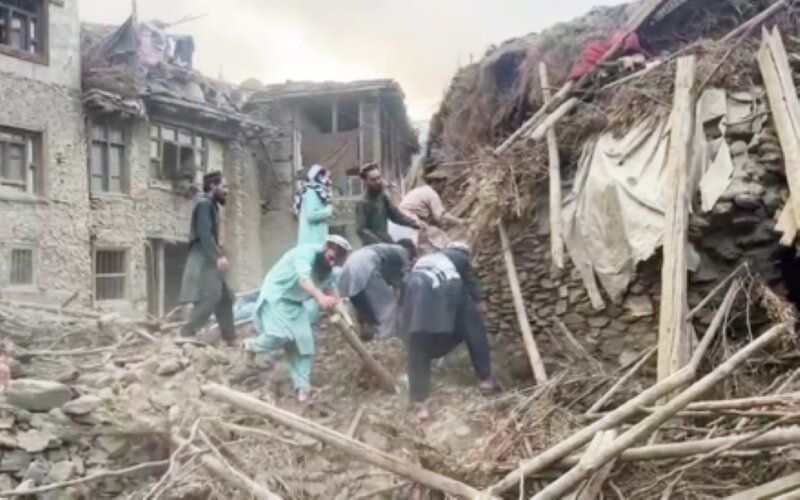
Late-night tremors rocked eastern Afghanistan, as a 6.0 magnitude earthquake struck the mountainous province of Kunar, leaving approximately 250 dead and over 500 injured, officials from the Natural Disaster Preparedness Authority confirmed. The lopsided toll, they cautioned, remains provisional, as contact with remote communities is only beginning to be restored.
The quake’s fury was compounded by two aftershocks—a 5.2 and a 4.7—all centered near Jalalabad, as per the United States Geological Survey. The seismic waves devastated the districts of Nurgal, Sawkay, Watapur, Manogi, and Chapa Dara, while also delivering blowback in Hurrah-filled valleys of Nangarhar and Laghman, with tremors felt as far away as Kabul and into Pakistan’s neighboring Khyber Pakhtunkhwa.
In Nurgal, entire villages lie buried under shifting soil. Rescue teams—organized by the Ministries of Defense, Interior, and Public Health—have mobilized swiftly, their operations punctuated by urgent helicopter airlifts ferrying the wounded to Nangarhar Regional Hospital. Yet hundreds are believed to remain trapped beneath the debris, and families are desperately calling for help, their pleas reaching beyond the canyon-walled villages.
Zabihullah Mujahid, spokesperson for the Islamic Emirate of Afghanistan, urged that “local officials must marshal all available resources” to spearhead rescue efforts. His statement underscores the gravity of the crisis: lives hang in the balance amid unstable terrain and unpredictable aftershocks.
Communication links are gradually being reestablished, but in this rugged terrain, time is cruel. As local responders and makeshift rescuers dig through the rubble, the hope of pulling survivors from the depths persists—not just as a duty, but as a testament to resilience under quake-scarred skies.