Ukraine unleashed one of its most extensive drone barrages on Russia over the weekend, forcing a reactor at the Kursk nuclear power plant to halve its output and igniting a massive fire at a key fuel export hub on the Baltic Sea, Russian officials said Sunday.
The attacks underscored the war’s expanding front as Ukraine marked its Independence Day on August 24, the anniversary of its 1991 break from the Soviet Union. Russia’s Defense Ministry claimed its air defenses intercepted at least 95 drones across more than a dozen regions, in what appeared to be a coordinated strike reaching from the southern border to the far north.
At the Kursk plant—just 38 miles from Ukraine—a drone detonated near auxiliary equipment, damaging a transformer and triggering a blaze that forced reactor No. 3 to operate at half capacity. Officials stressed that radiation levels remained normal and no injuries were reported. Two other reactors at the Soviet-era plant were idle, with one under repair.
The International Atomic Energy Agency confirmed it was monitoring the situation, reiterating that all nuclear sites “must be protected at all times.”
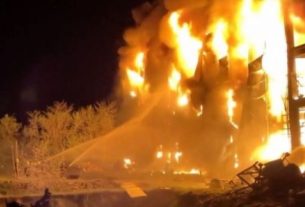
Nearly 1,000 kilometers north, in Russia’s Leningrad region, falling drone debris sparked a fire at the Ust-Luga fuel export terminal, operated by Novatek. The sprawling complex, which processes gas condensate into jet fuel, naphtha, and fuel oil for Asian and European markets, sent plumes of black smoke into the sky. Local governor Alexander Drozdenko said firefighters contained the blaze without casualties.
Rosaviatsia, Russia’s civil aviation agency, reported that multiple airports—including St. Petersburg’s Pulkovo—halted flights for hours during the overnight assault.
Further south, in the Samara region, drones hit an industrial facility in the city of Syzran, injuring a child, officials said. Earlier this month, Kyiv targeted the nearby Rosneft-owned oil refinery, briefly halting operations.
Ukraine has not commented on the latest strikes, but officials in Kyiv routinely frame attacks inside Russia as retaliation for Moscow’s relentless missile barrages and as efforts to disrupt infrastructure critical to the Kremlin’s war machine.
As both sides talk of peace while trading blows, Europe’s bloodiest conflict since World War II shows little sign of abating.