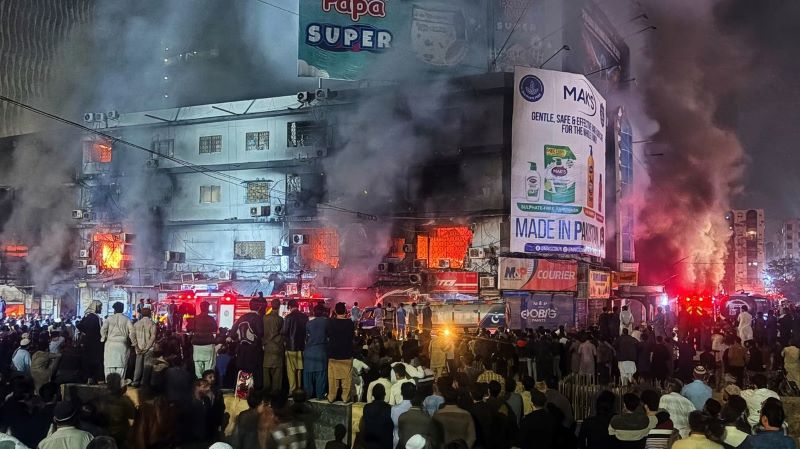
The charred skeleton of Gul Plaza stands as yet another monument to official negligence and systemic corruption in Pakistan, where fire safety exists only on paper and lives are expendable commodities in the calculus of graft, according to Dawn News.
Twenty one confirmed dead. Seventy still missing. These aren’t merely statistics; they’re daughters who went shopping on a Saturday evening, shopkeepers closing up for the night, families whose final moments were spent trapped behind locked emergency exits while flames consumed everything around them.
Sindh Chief Minister Murad Ali Shah announced ten million rupees for each victim’s family on Monday, a gesture that rings hollow when set against decades of willful neglect. Money cannot resurrect the dead or explain why a shopping plaza in Pakistan’s commercial capital lacked functioning fire suppression systems, why emergency exits were padlocked, why only three of sixteen gates were open when catastrophe struck.
This is not Karachi’s first funeral pyre, nor will it be its last. The city’s history is written in ash: Bolton Market in 2009, Timber Market in 2014, and now Gul Plaza in 2025. Each disaster follows an identical script initial shock, promises of reform, compensation announcements, then collective amnesia until the next conflagration.
The pattern reveals something darker than mere incompetence. It exposes a culture of corruption so pervasive that building inspectors rubber-stamp death traps, municipal officials ignore violations in exchange for bribes, and political leaders prioritize photo opportunities over enforcement. Fire safety regulations exist in Pakistan, comprehensive and modern on paper. Their fatal flaw is that nobody enforces them.
Consider the damning details: firefighters arrived to find insufficient water supply. The nearest fire station sits minutes away, yet response came hours too late. When flames finally drew attention, rescue teams discovered the building’s structural integrity so compromised that forty percent had collapsed. How did such a structure pass inspection just months prior? The answer lies in the greased palms and political connections that lubricate Karachi’s construction industry.
Traders and residents didn’t mince words. They pointed to the Saddar Fire Station’s proximity and questioned why full firefighting resources weren’t mobilized immediately. They noted the deplorable condition of M.A. Jinnah Road, so poorly maintained that positioning water tankers becomes a logistical nightmare. They asked where the mayor was, where the ministers were, as their neighbors burned alive.
These questions hang unanswered in Karachi’s acrid air, absorbed into the same civic indifference that allowed this tragedy. Pakistan’s civil society, once vibrant and vocal, has grown weary and cynical. The courts, theoretically independent arbiters of justice, remain conspicuously silent on systemic failures that claim hundreds of lives with predictable regularity.
International condolences poured in from British, German, and French diplomatic missions, highlighting what should shame Pakistan’s leadership; foreign governments express more concern for Pakistani citizens than their own elected officials demonstrate through action.
Chief Minister Shah promises forensic investigations and building reconstruction. Governor Kamran Tessori vows rehabilitation. These pledges sound hauntingly familiar because they’ve been made before, after every major fire, every preventable disaster. The committees form, the investigations proceed, reports gather dust, and the cycle continues.
Until Pakistan confronts the corruption that transforms building codes into suggestions and fire safety into optional expenses, until officials face consequences for negligence that kills, Gul Plaza will merely be another name in a lengthening obituary. The question isn’t whether another fire will come, but when and how many more will die before accountability becomes more than an empty promise whispered over mass graves.