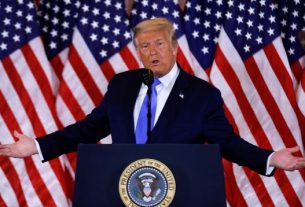
Russia has reacted with open approval and barely concealed glee to renewed tensions between the United States and Europe over former President Donald Trump’s claims that American control of Greenland is vital for security in the Arctic.
Trump has repeatedly warned that Russia and China are expanding their military presence near Greenland, citing Russian submarines and naval vessels in the region. Framing the Arctic as a growing strategic battlefield, he has argued that U.S. control of the vast, resource-rich island is essential to counter rival powers.
Rather than denying such ambitions or expressing concern over Washington’s rhetoric, Russian state linked media have welcomed Trump’s stance. In an unusual display of admiration, Rossiyskaya Gazeta, the Russian government’s official newspaper, praised Trump while sharply criticizing European leaders who oppose any U.S. annexation of Greenland. The paper accused Denmark and other European nations, including Britain and France, of obstructing what it described as a “historic breakthrough” for the United States.
The publication went further, portraying a hypothetical U.S. annexation of Greenland as a defining moment in American history. If completed by July 4, 2026, it argued, Trump would secure his place alongside Abraham Lincoln and the great territorial expansions of the 19th century. The paper even warned Trump against retreating from the idea, suggesting that backing down could weaken Republicans in U.S. midterm elections.
This striking endorsement is not driven by sympathy for American ambitions, but by Moscow’s strategic calculations. Trump’s rhetoric on Greenland and his threats to impose tariffs on European countries resisting the plan, have strained transatlantic relations and unsettled NATO unity. For the Kremlin, any development that weakens cohesion among Western allies is seen as advantageous.
Russian tabloid Moskovsky Komsomolets captured the mood bluntly, declaring that Europe’s confusion over the Greenland debate was “a pleasure to watch.” Pro Kremlin commentators have also used Trump’s statements to argue that territorial expansion remains a legitimate tool of great power politics, an argument that echoes Moscow’s own justification for its war in Ukraine.
For Russia, the stakes are clear. Securing victory in Ukraine remains the Kremlin’s central objective, and maintaining a favorable relationship with a Trump-led United States is viewed as a potential pathway toward that goal. As a result, Moscow’s media criticism is aimed squarely at Europe, not at Trump, whose actions are seen as sowing division where Russia stands to benefit most.