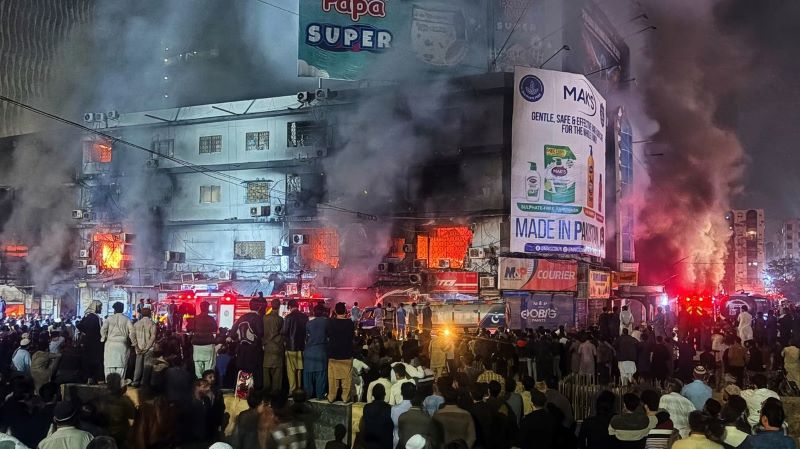
A catastrophic fire at a bustling shopping complex in Karachi, Pakistan, has claimed at least 61 lives, with rescue workers discovering thirty bodies in a single crockery shop where victims had sought refuge from the flames. The grim discovery at Gul Plaza has transformed what began as a weekend shopping expedition into one of the nation’s deadliest commercial disasters, according to Dawn News.
The tragedy unfolded Saturday night when fire engulfed the multi-story retail center located on a major thoroughfare in Pakistan’s largest city. What witnesses initially hoped would be a quickly controlled blaze evolved into a relentless inferno that burned for over twenty four hours, reigniting repeatedly from smoldering debris even after firefighters believed they had extinguished it.
Deputy Inspector General Syed Asad Raza revealed the heartbreaking details: thirty bodies were recovered from Dubai Crockery, a shop situated on the building’s mezzanine level. The victims had apparently believed themselves safe, maintaining contact with the outside world until they succumbed to suffocation while awaiting rescue that arrived too late.
“As per the last contact with the victims, they believed they would be safe and the fire would be controlled,” Raza explained, his words conveying the cruel irony of their final moments. “They suffocated to death while waiting.”
Local resident Rasheed provided context for the shop’s unusual occupation that evening. Dubai Crockery had been conducting a special wedding season sale, extending its operating hours until 2:00 AM, four hours beyond its typical closing time of 10:00 PM. The promotional event had drawn crowds seeking bargains for upcoming celebrations, unwittingly placing dozens in harm’s way.
The shopping plaza itself presented a labyrinth of commercial activity: a ground-plus-three-story structure housing 1,200 individual shops across approximately 8,000 square yards. Portions of the building collapsed during the conflagration, complicating rescue efforts and raising fears of additional casualties buried beneath rubble.
Karachi Commissioner Syed Hassan Naqvi, leading a government-appointed inquiry committee, surveyed the devastation and lamented the building’s inadequate safety measures. “The fire safety measures inside the buildings did not adhere to international standards,” he observed, highlighting a systemic failure that may have contributed to the catastrophic death toll.
Building records indicate the structure originated in 1979, with subsequent renovations approved in 1998 and regularization completed in 2003. Official documentation specified sixteen emergency exits on the ground floor alone, yet investigators discovered that fourteen of these crucial escape routes were locked when the fire erupted; a detail that transforms architectural compliance into tragic negligence.
The fire’s timing proved particularly devastating. The market was preparing to close for the evening, prompting staff to secure exits, a routine security measure that became a death sentence when flames spread rapidly through the tightly packed commercial spaces.
Firefighting Chief Zafar Khan defended his department against allegations of delayed response, asserting that three fire engines were dispatched immediately upon receiving Saturday night’s emergency call. He described chaotic scenes where panicked shopkeepers allegedly wrestled hoses from firefighters, attempting to protect their own establishments while the blaze spread unchecked. Additionally, the door providing roof access remained locked, eliminating a potential escape route.
The adjacent Rimpa Plaza, a thirteen story building, sustained structural damage from prolonged heat exposure. Building authorities identified two weakened support pillars requiring immediate reinforcement with steel jacketing, a process already underway to prevent further collapse.
As DNA testing proceeds to definitively identify victims, investigators emphasize that no evidence of arson or sabotage has emerged. The inquiry committee pledges comprehensive recommendations to prevent future tragedies, though such assurances offer cold comfort to families mourning loved ones who perished seeking wedding decorations and household goods.
The disaster underscores persistent challenges facing developing nations: inadequate building codes, insufficient enforcement, and the deadly consequences when commercial pressures override safety protocols.