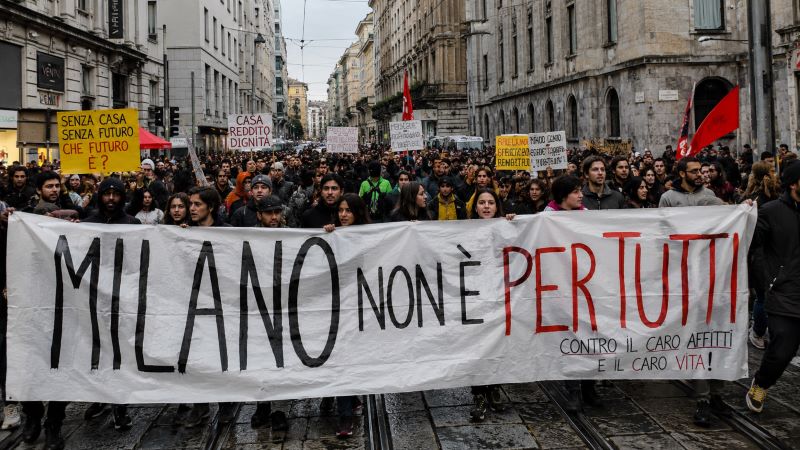
Protests against Italy’s rising cost of living turned violent on Saturday, leaving 50 people detained in Milan and triggering clashes with police in Turin and Bologna, reported by Euro News.
The unrest followed demonstrations inspired by recent protests in France over the economic crisis. What began as a march against price rises and economic hardship deteriorated in Milan, where masked groups confronted police near Via Broletto and later in Piazza Duomo.
Police responded with tear gas, water cannon and hydrants as protesters set off fire extinguishers, fireworks and firecrackers, and threw rubbish bins, barriers and other objects. Several shops were vandalised, a portable toilet was set alight and furniture and street fixtures were damaged in nearby streets.
The violence spread to the Galleria Vittorio Emanuele II, forcing the closure of the M1 and M3 metro stations. Twenty-five people were taken to hospital, including ten police officers, although none was reported to be in a life-threatening condition. By the end of the day, 50 people had been detained, half of them minors.
Similar scenes unfolded in Turin, where hooded young protesters used bins, tables and chairs as barricades and threw bottles, stones, sticks and firecrackers at officers. Police stopped 12 people, 10 of them minors, some allegedly carrying petrol bombs, cobblestones and window-breaking hammers.
In Bologna, clashes centred on the railway station and Piazza Medaglie d’Oro. A group broke away from the march, throwing smoke bombs, bottles and barriers, while police used water cannon and tear gas. Seven people were detained.
Prime Minister Giorgia Meloni defended the right to protest but condemned the violence, saying: “Demonstrating is a right. Setting our cities ablaze is not.” She urged opposition parties to condemn the disorder without ambiguity, arguing that hesitation could become a justification for violence.
Her coalition allies took a harsher tone. Deputy Prime Minister Antonio Tajani accused parts of the centre left of “fanning the flames,” while Transport Minister Matteo Salvini sharply criticised those involved in the disturbances.
Milan Mayor Giuseppe Sala struck a more measured note. He said the reasons behind the protest were understandable, but insisted that violence against police and damage to the city were unjustifiable.
Opposition figure Pierfrancesco Majorino also condemned the violence, but warned against using it to criminalise students who had marched peacefully over housing, education and their future.
The protests exposed a widening divide; widespread economic frustration on one side, and a political battle over how far dissent may go before it becomes destruction.