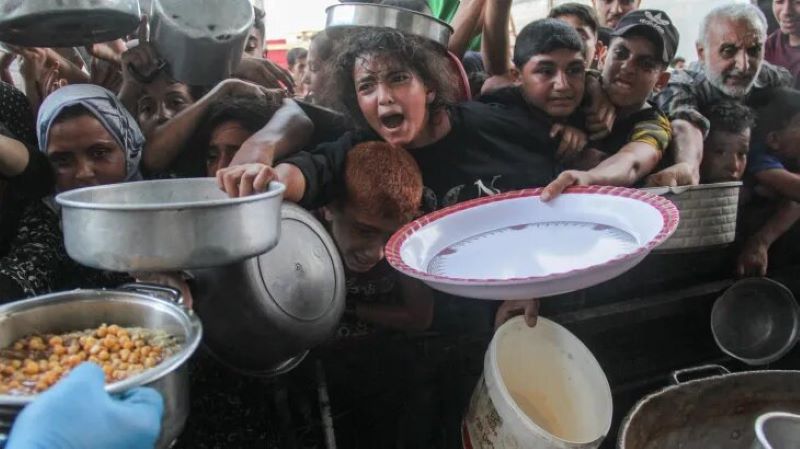
Prime Minister Benjamin Netanyahu’s decision to maintain a tight blockade and resume military operations in Gaza has driven the Palestinian territory to the edge of starvation, warn leading food security experts, reported by Arab News. The Integrated Food Security Phase Classification (IPC), an international authority on hunger crises, issued a dire report on Monday: if Israel does not lift its blockade and halt its offensive, outright famine is the most likely outcome for Gaza’s 2.3 million residents.
According to the IPC findings, nearly half a million Gazans now suffer “catastrophic” hunger, facing the real threat of starvation, while another million endure “emergency” levels of food deprivation. These stark figures were gathered between April and May 6, 2025, revealing a landscape where markets lie bare, farms have been ravaged by conflict, and communal kitchens—the last lifeline for many—are running dry.
For the past ten weeks, Israel has barred all supplies of food, water, medicine, and fuel from entering Gaza. As airstrikes and ground operations continue, the enclave’s modest agricultural capacity has been all but wiped out. In public kitchens, desperate families wait four or five hours in the baking sun, pots in hand, only to depart empty-handed. “We stand in line until our strength fades, and still there is nothing,” lamented Riham Sheikh el-Eid, one of many queuing for a single bowl of lentils.
International observers stress that a formal famine declaration is not needed to recognize the suffering already underway. Chris Newton of the International Crisis Group accused the Israeli government of wielding starvation as a weapon of war, aimed at obliterating Hamas in Gaza. “They are starving an entire population,” he said, “using hunger to break the will of its people.”
Israel defends its stance by demanding a new aid distribution mechanism under its direct control, alleging that Hamas diverts supplies. The United Nations and humanitarian groups reject these claims, warning that such a system would politicize relief and fail to meet Gaza’s colossal needs. Meanwhile, the United States has proposed an alternative aid route, though the UN has declined to participate, calling the plan inadequate.
With nearly every family caught in the vise of hunger, experts warn that any further delay in reopening Gaza’s arteries of aid will tip the region into famine. “Every day we wait, we inch closer to the abyss,” said QU Dongyu, Director-General of the UN Food and Agriculture Organization. Unless the blockade ends—and relief flows once more—Gaza’s children and elders face an unbearable march toward starvation.