

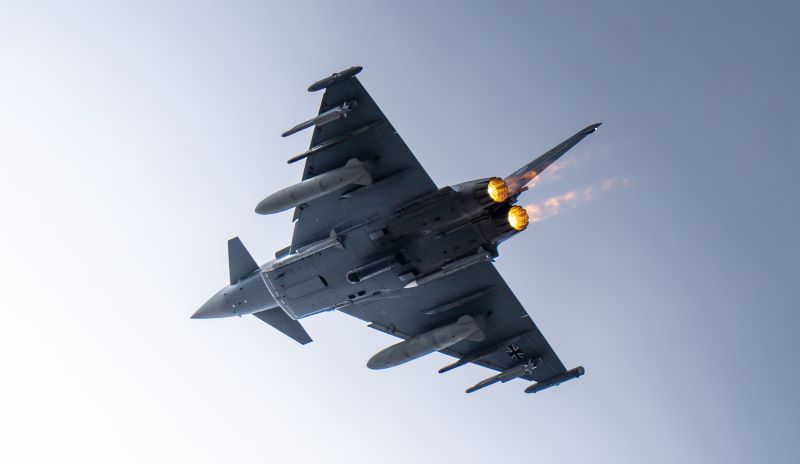
Twenty five years after Austria’s controversial fighter jet purchase, three men will stand trial in Vienna starting March 10, accused of orchestrating a 65-million-euro fraud scheme involving the Eurofighter deal, according to Austrian Press Agency.
A former aviation manager and two weapons lobbyists face charges of embezzlement through an elaborate bribery operation that allegedly drained funds from European aerospace giant EADS. Court officials have scheduled seven hearing dates through March 27 to untangle the complex financial web.
At the scandal’s core lies Vector Aerospace LLP, a shell company prosecutors say existed solely as a “black money fund.” Nearly 90 million euros flowed through this corporate phantom, which conducted no legitimate business. The money was then distributed to weapons lobbyists, business representatives, and unidentified recipients, according to the Economic and Corruption Prosecutor’s Office.
To hide the bribes, conspirators allegedly created fake contracts with shell companies and fabricated invoices to disguise the payments.
The defendants have proclaimed their innocence, claiming no actual damage occurred and arguing the statute of limitations has expired. Vienna’s Higher Regional Court rejected those defenses, allowing prosecutors to present their evidence before a jury panel.
The German ex-manager allegedly helped transfer funds from EADS Deutschland into the slush fund. The two suspected lobbyists were reportedly “deployed by the Eurofighter consortium during the Austria campaign” to secure the contract and allegedly participated in creating fraudulent documentation.
The controversy began in 2000 when Austria’s government under Chancellor Wolfgang Schüssel decided to purchase new interceptor jets. The Eurofighter was unexpectedly selected in 2002 to replace the aging Draken fleet, and the contract was signed in 2003.
Public suspicion triggered three parliamentary investigations starting in 2006. Despite years of inquiries, the legal process has moved glacially. Only in 2019 did Austria’s specialized corruption prosecutors take over the case.
Now, a quarter-century later, the courtroom may finally provide answers.





