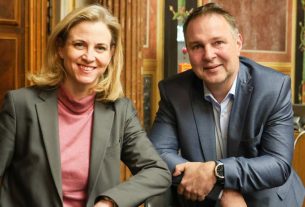
According to an interview with the Austrian Press Agency (APA), reported by Die Presse, Austria’s Integration Minister Claudia Plakolm (ÖVP) is considering tightening the country’s Islam Law due to concerns about certain mosques. While discussions are ongoing, she did not specify what changes might be made.
Plakolm also spoke about Austria’s mandatory military service, but she did not confirm whether civilian service would also be extended. She explained that this decision would depend on recommendations from an expert commission. However, she did announce the return of an extended voluntary civilian service program. This program would help young men transition between school and vocational training while also supporting institutions that rely on civilian workers.
One of the most debated topics is the government’s proposed headscarf ban for girls under 14. Plakolm argued that Austria should not allow young girls to be oppressed and pointed out that veiling is common in countries where radical Islam is growing. A specific plan for the ban has not yet been finalized, but she suggested a step-by-step approach. This could start with conversations with parents, followed by meetings with school psychologists, and eventually lead to possible consequences. She stressed that the ban must be legally strong to be effective.
Plakolm also supports a mandatory integration program for asylum seekers and refugees expected to stay in Austria. She believes it should include clear rules and consequences for those who do not follow them. She pointed to models in Lower and Upper Austria, where failing to meet integration requirements can result in a 50% reduction in social benefits. According to her, this approach has proven effective.
The minister also expressed concerns about radicalization in some mosques and stated that Austria should reconsider its current Islam Law. She emphasized that action is needed to prevent extremist ideologies from spreading in religious spaces.
Beyond legal and integration policies, Plakolm spoke about the importance of preserving Austria’s cultural traditions. She believes society should embrace its customs rather than distance itself from them. She highlighted celebrations like St. Martin’s Day and the Harvest Festival, which promote values of sharing and unity. She wants to ensure that these traditions continue in schools, even those without Catholic students.
Austria’s Protestant community, hoping for Good Friday to return as a public holiday, received disappointing news. Plakolm clarified that the government has no plans to reinstate it, as the holiday was removed due to a court ruling rather than a political decision. However, she promised to discuss the issue with Protestant representatives.