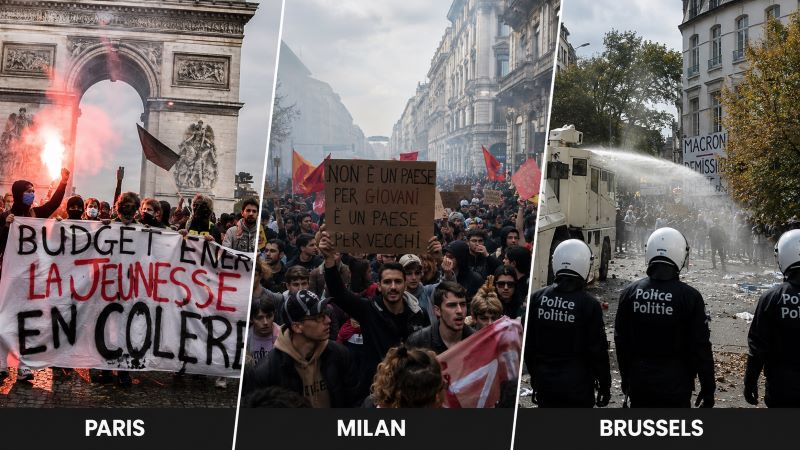
European cities are preparing for another tense weekend as fears of fresh violence grow following days of protests, clashes and destruction. From Paris to Milan and Brussels, authorities are increasing security, businesses are protecting their property, and cultural institutions are closing their doors in anticipation of possible unrest.
France is at the centre of the growing crisis, with around 70,000 security personnel expected to be deployed nationwide. Interior Minister Laurent Nuñez has warned of online calls for attacks on public buildings, looting and violence against police. The government has vowed to respond firmly, while President Emmanuel Macron has pledged to break up unauthorised demonstrations and change the routes of approved marches to protect shops and public buildings, reported by the Kronen Zeitung.
The unrest began with student protests over staff shortages, deteriorating school facilities and poor learning conditions. Anger deepened after the government proposed €54 billion in budget cuts for 2027, raising fears that education and other public services would suffer further. Rising living costs and high energy prices have added to public frustration.
What began as largely peaceful demonstrations has increasingly drawn violent groups, turning parts of the country into scenes of destruction. Reports in the supplied account describe attacks on businesses, fires, clashes with police and thousands of arrests. The government says it is determined to prevent a repeat of the previous weekend’s violence.
Paris is already showing signs of the strain. The Louvre, the Musée d’Orsay and other cultural institutions have announced closures, while the Art Basel Paris fair will remain shut for the weekend. Shopkeepers have covered their windows with wooden boards, fearing looting and damage. Authorities have also urged residents and businesses to remove objects that could be used as weapons or barricades.
Italy is taking similarly strong precautions. In Milan, 500 soldiers from the elite Folgore paratrooper division are expected to support police, with armoured vehicles and drones available if needed. The government has also introduced tougher security measures following recent unrest. Demonstrations are being called through social media, with some online messages reportedly encouraging protesters to break through police barriers.
In Brussels, officials are considering additional restrictions after vehicles were set on fire during earlier protests. Rental electric scooters and bicycles may be removed from the historic city centre to reduce the risk of further arson.
Concerns have also been reported in Albania, Spain and Portugal, while German authorities face separate calls for street violence around Halloween.
Across Europe, the mood is uneasy. Governments are trying to maintain public order, while protesters continue to voice concerns about education, living costs and spending cuts. The challenge now is to prevent violence without silencing peaceful dissent, as cities brace for a weekend that could test both public patience and political resolve.