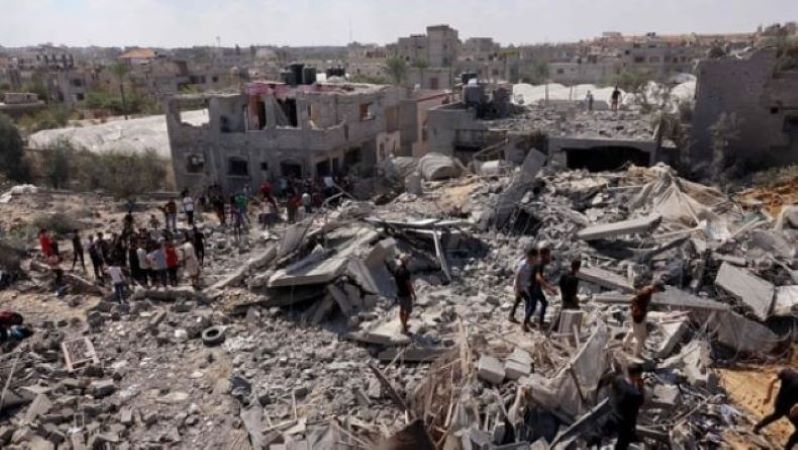
GENEVA — A new United Nations report has sounded the alarm over a catastrophic humanitarian situation in Gaza, warning that the ongoing conflict has regressed development in the region by an astonishing seven decades. This regression threatens not only the people of Gaza but also future generations of Palestinians.
Catastrophic Humanitarian Impact
Achim Steiner, Administrator of the United Nations Development Programme (UNDP), noted that the new assessment highlights a serious development crisis alongside the immediate suffering and loss of life. “Projections confirm that, even with ongoing humanitarian aid, the economy may not recover to pre-crisis levels for a decade or more,” he stated during the report’s launch.
Alarming Economic Indicators
The report presents alarming statistics, predicting that poverty in the Gaza Strip and the Israeli-occupied West Bank could soar to 74.3% by 2024, a drastic increase from 38.8% at the end of 2023. This shift would affect approximately 4.1 million people, including 2.61 million newly impoverished individuals.
The economic situation is dire, with the gross domestic product (GDP) expected to contract by 35.1% this year. Unemployment is also anticipated to rise dramatically, potentially reaching 49.9%. “In Gaza, unemployment is nearing 80%,” said Chitose Noguchi, Deputy Special Representative for the UNDP’s assistance programme for Palestinians. “Three in four people are now living in poverty.”
A Diminished Human Development Index
The assessment reveals that the Palestinian territories are experiencing an unprecedented setback in development, with the Human Development Index (HDI) projected to drop to levels not seen since 2004. The report anticipates Gaza’s HDI will plummet to 0.408, effectively erasing over 20 years of development progress, while the West Bank’s HDI is expected to decline to 0.676, representing a loss of 16 years.
Recovery Scenarios
The report outlines three possible scenarios for early recovery, including “Restricted Early Recovery” and “No Early Recovery.” Both scenarios hinge on the continuation of strict bans on Palestinian workers and the withholding of funds from the Palestinian Authority. The only variable is the level of humanitarian aid allocated, currently estimated at around $280 million annually.
“Even if this aid were maintained for ten years, simulations show that it alone cannot put the Palestinian economy back on track,” Noguchi cautioned. She emphasized the need for significant investment to support recovery efforts, urging for the lifting of current restrictions that stifle economic growth.
Urgent Need for Reconstruction
The enormity of the task ahead is underscored by the staggering toll of the conflict, which has seen nearly 43,000 people killed and approximately 100,000 injured, alongside extensive destruction of essential infrastructure. A World Bank report from April estimated the damage to critical infrastructure in Gaza at around $18.5 billion.
Rola Dashti, Executive Secretary of the UN’s Economic and Social Commission for Western Asia, called for immediate action, stating, “Our assessments highlight the millions of lives shattered and decades of development efforts wiped out. It is high time to end the suffering and bloodshed that has engulfed our region.”
As the conflict persists, the need for a lasting solution that allows all peoples to live in peace and dignity becomes increasingly urgent.