

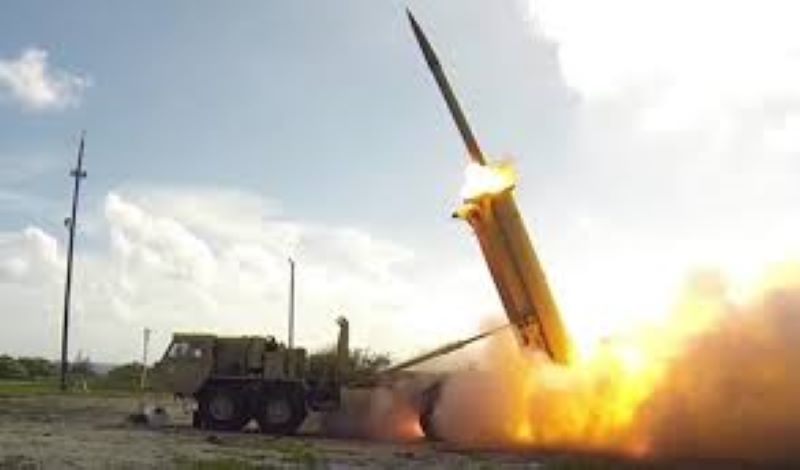
NEW YORK — In the wake of Iran’s retaliatory missile onslaught following strikes on its nuclear infrastructure, the United States expended an estimated $800 million deploying its advanced Terminal High Altitude Area Defense (THAAD) system to protect Israeli airspace, according to Newsweek and defense sources, reported by APP.
During the intense 12-day conflict, which saw cities across Israel targeted by ballistic and hypersonic missiles—including Iran’s Fattah-1, reportedly capable of reaching speeds up to Mach 15—the U.S. is believed to have used 15 to 20 percent of its global THAAD interceptor inventory. The defensive operation marked one of the largest real-world deployments of THAAD, a Lockheed Martin-developed system long relied on by Israel and stationed globally by the U.S., including in Guam.
Although the Pentagon declined to comment, reports from Bulgarian Military News and Military Watch Magazine confirm the unprecedented scale and cost of the deployment. Each THAAD interceptor carries a hefty price tag, ranging from $12 million to $27 million when factoring in production, research, and testing.
The U.S. military operates seven THAAD batteries, with an eighth currently being integrated into the Missile Defense Agency to enhance hypersonic tracking capabilities. The battery deployed to Israel in 2024 had already undergone partial restocking amid concerns about depleted munitions.
This deployment reflects growing tensions in the region and the mounting burden of U.S. military commitments abroad. Experts warn that sustaining high-cost missile defenses for allied nations could strain readiness and limit future response flexibility—especially as threats evolve toward faster, harder-to-intercept weapons.
As geopolitical pressures intensify, the price of protection is becoming increasingly steep—for allies, and for the American taxpayer.





