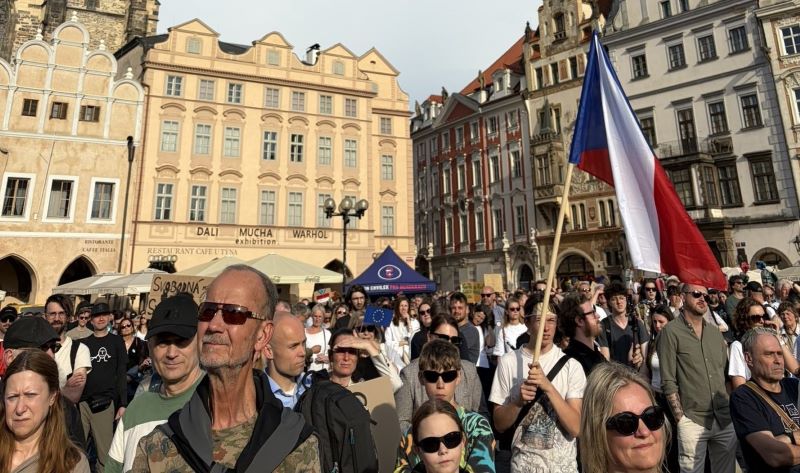
Tens of thousands of Czechs poured into the heart of Prague over the weekend to defend something most democracies take for granted: the idea that a news broadcaster shouldn’t answer to whoever is writing the government’s checks, reported by Czech Media.
Demonstrators raised banners reading “Hands off the media” and “Independence has its price”, a pointed message aimed squarely at Prime Minister Andrej Babiš, the billionaire populist whose coalition government is pushing a plan that critics say could quietly strangle Czech public broadcasting.
The rally was organized by the civic movement A Million Moments for Democracy. More than 175,000 people also signed an online petition opposing the proposal, according to organizers.
At the center of the controversy is a plan to abolish the existing license fee system that funds Czech Television (ČT) and Czech Radio (Český rozhlas). Starting in 2027, both broadcasters would instead receive their budgets directly from the state, roughly the equivalent of 320 million euros per year. That sounds stable enough on paper. But here’s the catch: that figure represents about 15 percent less than what the broadcasters currently collect through license fees. And more troubling to many journalists, media experts, and ordinary citizens is the question of who decides how much they get each year and whether that money could be quietly squeezed whenever the government disapproves of a particular story.
Critics are calling it “nationalization” of public media in all but name. When a broadcaster depends on annual budget allocations approved by politicians, the editorial room is never truly free, that is the argument being made in cafés, universities, and living rooms across the country.
The government driving this change is itself a striking coalition: Babiš’s right-wing populist ANO party joined forces with the far-right Freedom and Direct Democracy movement (SPD) and the motorists’ lobby party known as the Motorists. Together, they have held power since mid-December.
For a country that lived through decades of state-controlled media under communism, the imagery is hard to ignore. Protesters know what it looks like when a government controls the story. That’s precisely why so many of them showed up.__Photo Courtesy X