Spain has faced its most widespread industrial disruption in 14 years as unions staged a general strike over housing costs and the rising price of living, less than three weeks before a parliamentary election, according to BBC News.
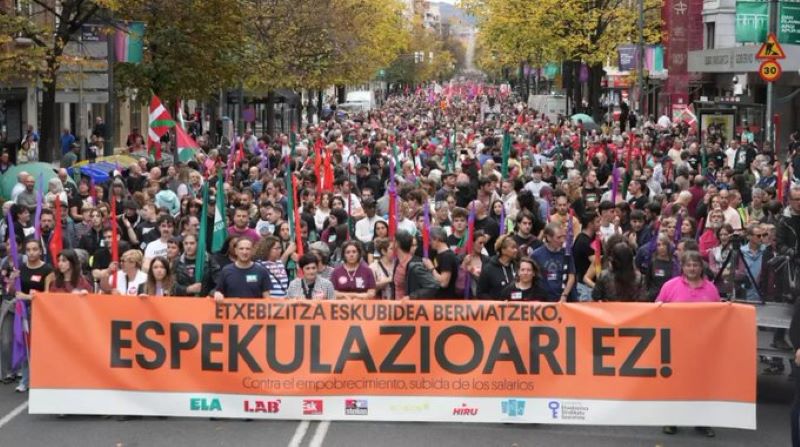
Transport and public services were severely affected across the country, with some of the biggest disruption in Madrid and Catalonia, one of Spain’s main industrial regions. Traffic was halted on several major roads, while tens of thousands of people joined demonstrations in Madrid and Barcelona during the evening.
The strike was called by Spain’s largest unions, UGT and CC OO. UGT leader Pepe Álvarez described participation as “massive,” while CC OO chief Unai Sordo said turnout was “very significant.” However, the Spanish Confederation of Business Organisations said participation was “low and uneven,” varying by region and sector.
The action was fuelled by anger over unaffordable housing and growing living costs. It followed the eviction of 87-year-old Maricarmen Abascal from a Madrid flat where she had lived for seven decades. She died in hospital weeks later.
Rents in the capital have risen sharply. In October, the average monthly cost of a 50-square-metre apartment in Madrid was €1,170, according to property portal Idealista. That is nearly half of Spain’s average gross monthly salary of about €2,460, far above the 30 per cent affordability level often recommended by housing experts.
Prime Minister Pedro Sánchez called snap elections last month after parliament failed to approve his housing reform plan. Unlike earlier general strikes, his government has encouraged workers to take part, framing affordable housing as a collective right.
“Your eight-hour day. Your pension. Your public healthcare… These were collective conquests,” Sánchez wrote on social media, praising earlier labour struggles.
The conservative People’s Party, which leads opinion polls, accused the government of using the strike for political advantage. Party leader Alberto Núñez Feijóo called the action “nonsense” and described the unions as “mafia” and “trash.” Party spokesman Miguel Tellado said the government was trying to warn voters against a right-wing government after the 29 November election.
Among the strikers was Gonzalo Álvarez, 27, who volunteers for a housing union in Madrid. He said Abascal’s eviction was “the little fire” that sparked the protest. Álvarez and his girlfriend pay €1,000 a month for a small one-bedroom flat, leaving each with little money after other bills.
“You have to collect an insane amount of money to be able to buy a house,” he said. “With these salaries, it’s impossible.”
Business leaders also criticised the strike. Miguel Garrido, vice-president of the CEOE business association, said it was political rather than labour-related and closely linked to the early election.
Electricity use fell by 7.5 per cent during the early hours of Wednesday, according to grid operator Red Eléctrica. During the last general strike 14 years ago, consumption fell by more than 15 per cent.