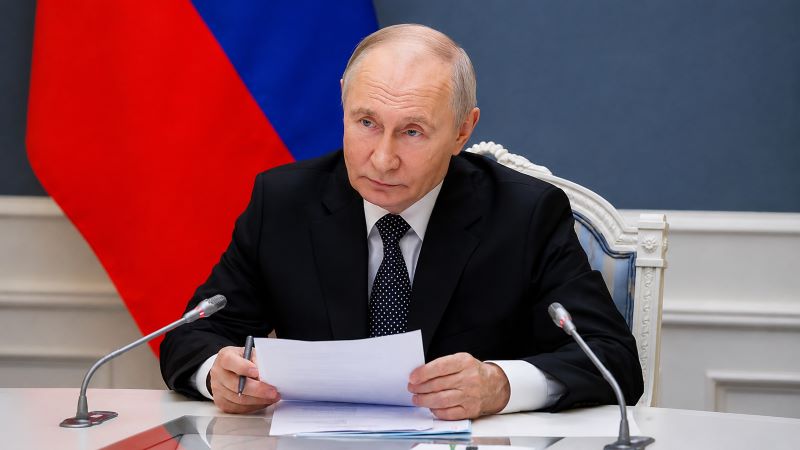
Russian President Vladimir Putin has rejected accusations that Moscow is stirring mass protests across Europe, describing the claims as a “clear overkill.” Speaking in an interview with the state run VGTRK broadcaster published on Sunday, he argued that the allegations say more about the weakness of European governments than about Russian influence, reported by Anadolu Agency.
Putin said his first response to the accusations was surprise. He noted that early commentary in Europe had initially focused on the United States, with some officials blaming the current American administration and its support for right wing parties and movements for the unrest. Such criticism, he said, was unexpected because European leaders appeared to be attacking their main military ally across the Atlantic.
According to the Russian president, European officials soon returned to what he called their “traditional accusations” against Moscow. “Russia has always been accused of all mortal sins,” he said, adding that he was prepared to answer the latest claims.
Putin insisted that ordinary Europeans would see through suggestions that Russia was provoking demonstrations in major cities. He accused some leaders of refusing to examine the underlying causes of public anger, and instead shifting blame first to Washington and now to Russia. In his view, this reflected an inability to take responsibility for problems at home.
His remarks came as nationwide student protests continued in France for several weeks. French Foreign Minister Jean-Noel Barrot said on October 21 that the unrest had been exploited by “hostile narratives” from Russia, China, Iran and the MAGA movement in the United States.
The Kremlin has consistently denied any role in the protests. Spokesman Dmitry Peskov said on October 19 that nobody takes such “absurd accusations” seriously. US President Donald Trump, meanwhile, has blamed the unrest on mass migration.
The dispute highlights a familiar pattern in Europe’s political argument; as protests grow, governments and their critics compete to explain the anger through domestic hardship, foreign interference, migration or the failures of leadership itself.