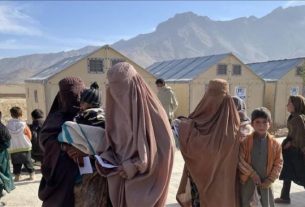
Pakistan has suspended all trade with Afghanistan, declaring that commercial activity will not resume until the Taliban government ends its alleged support for militant groups carrying out attacks inside Pakistan.
Foreign Office spokesperson Tahir Andrabi made the announcement at the weekly press briefing in Islamabad, stating that border crossings and trade routes remain sealed due to “the Afghan Taliban regime’s continued support to terrorist entities.” He said the border will reopen only when there is “complete cessation of this support and improved on-ground conditions.”
Andrabi stressed that agricultural imports from Afghanistan are also halted and warned that suicide attackers “will never be allowed entry.” Pakistan, he said, remains committed to regional connectivity but will pursue it “on its own terms” while strengthening broader trade diplomacy.
He welcomed Türkiye’s offer to mediate between Islamabad and Kabul and noted that Iran and Russia have also shown readiness to facilitate dialogue. Pakistan, he emphasized, remains in close coordination with all three countries.
Responding to questions about Afghanistan’s Bagram Airbase, Andrabi said Pakistan respects Afghanistan’s sovereignty and views issues related to the base as matters strictly between Kabul and Washington. He said public comments from Afghan-based figures “only validate Pakistan’s long-held concerns” about terrorist groups finding safe haven on Afghan soil.
Turning to the Middle East, Andrabi condemned the continuing Israeli violations in the occupied West Bank, including raids on Al-Aqsa Mosque and settler violence. He reiterated Pakistan’s support for a two-state solution based on pre 1967 borders, with Al Quds Al Sharif as the Palestinian capital.
The spokesperson voiced deep concern over the human rights situation in Indian Illegally Occupied Jammu and Kashmir, citing arbitrary arrests, restrictions on civil liberties, demographic changes, and cultural suppression. Pakistan urged the international community to ensure accountability and uphold UN Security Council resolutions on the disputed territory.
Addressing regional diplomacy, Andrabi said developments in Bangladesh are considered internal matters. He also appreciated U.S. efforts to reduce Pakistan-India tensions and acknowledged Washington’s engagement in Middle East diplomacy.
He reaffirmed Pakistan’s support for Iran’s right to peaceful nuclear technology and opposition to sanctions, while encouraging dialogue and extension of UN Security Council Resolution 2231.
Andrabi highlighted Deputy Prime Minister and Foreign Minister Ishaq Dar’s recent visit to Brussels, where he co-chaired the 7th Pakistan-EU Strategic Dialogue and met senior EU and NATO officials. Dar also led Pakistan’s delegation at the SCO heads-of-government meeting in Moscow and later held political consultations with Iran focused on trade, energy, connectivity, and regional issues.