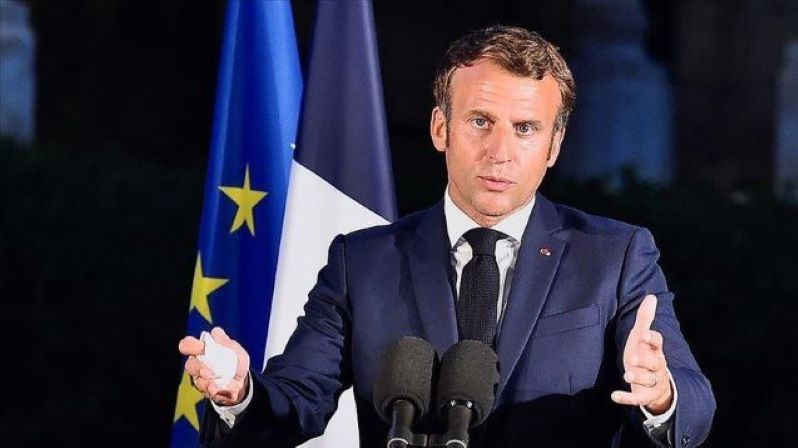
France will increase its nuclear warhead stockpile and deepen defense cooperation with European allies to strengthen the continent’s security, President Emmanuel Macron announced on Monday, according to AFP. Speaking at the country’s nuclear submarine base on the Île Longue peninsula, he outlined a new phase in France’s nuclear strategy shaped by growing global tensions and uncertainty over Europe’s future defenses.
“We must strengthen our nuclear deterrent in the face of multiple threats,” Macron said. He described a gradual shift toward what he called “advanced deterrence,” aimed at extending France’s protective reach across Europe while maintaining national sovereignty.
The announcement comes as Russia’s war against Ukraine enters its fifth year and as European members of NATO worry about the long-term reliability of U.S. security commitments. The escalating conflict between the United States, Israel, and Iran has added to fears that instability in the Middle East could spill closer to Europe.
Macron confirmed he had ordered an increase in France’s nuclear warheads but said the government would no longer disclose details about the size of its arsenal. France is estimated to possess about 290 nuclear warheads, making it the world’s fourth-largest nuclear power. Within Europe, only the United Kingdom also maintains nuclear weapons.
European Partners Join Deterrence Plan
Macron said eight European countries have agreed to join France’s new deterrence initiative: Germany, Britain, Poland, the Netherlands, Belgium, Greece, Sweden, and Denmark. Under the plan, French strategic air forces could be deployed across participating countries, complicating the calculations of potential adversaries and strengthening collective defense.
The cooperation may also include conventional support from allied militaries in nuclear-related exercises, Macron said, noting recent joint drills with British forces as an example.
Security experts, however, caution that building a shared European nuclear strategy would require deeper political unity than currently exists. Analysts Heloise Fayet and Claudia Major argued that Europe must eventually develop a deterrence approach rooted in its own interests rather than relying on the United States. “The era of strategic complacency is over,” they wrote.
Submarines at the Core of Deterrence
France’s sea-based nuclear force remains central to its strategy. The Île Longue base houses four ballistic-missile submarines, Le Triomphant, Le Téméraire, Le Vigilant, and Le Terrible, with at least one always on patrol to guarantee constant deterrence.
As Macron approaches the final stretch of his presidency, his nuclear initiative seeks to reassure allies and signal resolve. With wars raging on Europe’s edges and alliances shifting, France is positioning its nuclear shield as a cornerstone of the continent’s security in an uncertain age.