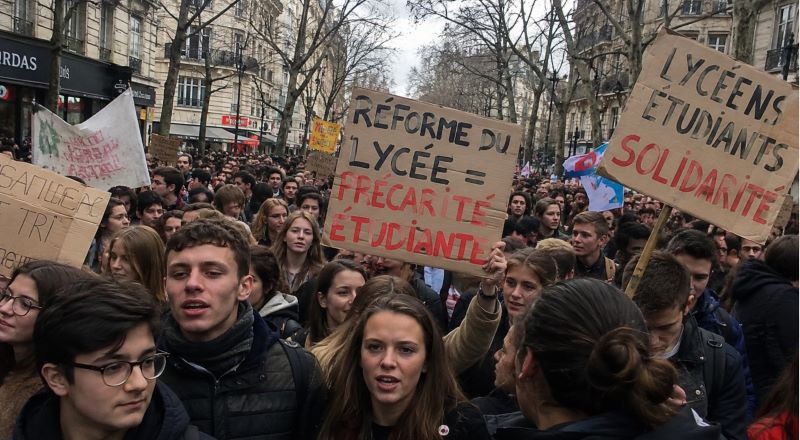
France witnessed one of its largest days of protest in years on Thursday, as more than 600,000 people joined rallies and strikes across the country to demand higher wages, stronger public services, and relief from the rising cost of living. The left-wing CGT union put the turnout far higher, at 1.57 million; a level it described as unmatched since 2023, according to BBC News.
The movement began in September with anger over conditions in France’s high schools, but it has since grown into a broader revolt. Students, university staff, public-sector workers, private employees, pensioners, and a revived “yellow-vest” movement have united around a simple grievance: everyday life has become too expensive.
Five unions joined the coordinated day of action, pressing the government for an increase in the minimum wage currently €12.31 an hour and for a net monthly pay rise of €100. “The only thing that will bring this mobilisation to a halt is responding to our demands,” CGT leader Sophie Binet said.
The protests brought visible disruption. Schools, hospitals, and public transport were affected; the Eiffel Tower and parts of the Louvre closed; and workers were asked to halt production at oil refineries. France was expected to import more electricity than it produced because of disruption at nuclear plants. Government figures showed that 9.89% of civil servants and 16% of teachers took part in the strikes.
In Paris, organisers had hoped to march from Place de la Bastille to Place de la Concorde, a route passing close to the National Assembly, the Élysée Palace, and the prime minister’s residence. Authorities instead redirected the demonstration from Place de la République to Place de la Nation.
Most of the day passed peacefully, but violence flared in several cities. In Lyon, a car was set alight near the Rhône river as radical “black bloc” activists clashed with police. In Rennes, masked groups confronted the main union march, while police used tear gas in Bordeaux. A teenager was injured in a stabbing during a high-school blockade in Seine-Saint-Denis, near Paris.
Interior Minister Laurent Nuñez had deployed 70,000 police officers and promised an “extremely firm response” to violence. Still, Thursday’s unrest remained smaller than the disturbances of 17 October, when more than 2,000 shops were looted and historic buildings were set on fire.
Under mounting pressure, Prime Minister Sébastien Lecornu announced that he would convene a “social conference” with unions and employers on Monday to discuss purchasing power and wages. The government has already released 10 million barrels of diesel from strategic reserves to reduce fuel prices and promised to reform the unpopular Parcoursup university admissions system by 2028.
Yet the government faces a difficult balance. It must respond to public anger while seeking tens of billions of euros in savings to reduce the budget deficit to 5% of GDP.
As night fell over Paris, the message from the streets remained clear: France’s cost of living crisis is no longer a background complaint, it has become a political force.