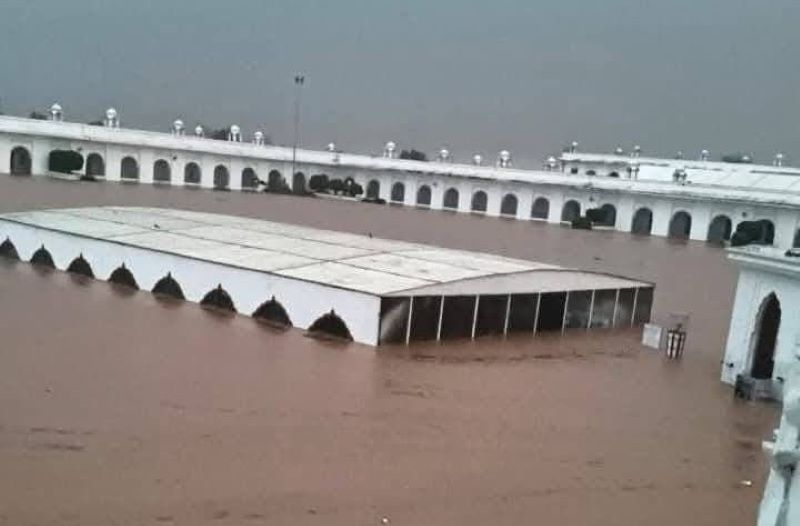
Floodwaters from the Ravi River surged into the revered Gurdwara Darbar Sahib in Kartarpur on Wednesday, submerging its marble steps and courtyard and forcing a sudden halt to pilgrimages at one of Sikhism’s holiest sites.
Videos from the site showed torrents sweeping across the shrine’s outer areas overnight. Officials confirmed that water reached nearly three feet in some parts of the complex, stranding an estimated 200 to 300 pilgrims in the Kartarpur Corridor before military and rescue units moved in to evacuate them.
The Punjab government had placed disaster management agencies on high alert a day earlier, warning of “exceptionally high” inundation risks. Weeks of monsoon rains, accelerated glacial melt, and the release of water from Indian dams have swollen rivers across Punjab province, displacing nearly 190,000 people so far.
The threat stretches across the border as well. In India’s Gurdaspur district, the historic town of Dera Baba Nanak — home to another sacred Sikh shrine and directly opposite Kartarpur — is also under strain. Rising waters fueled by relentless rainfall in Himachal Pradesh and Jammu and Kashmir have put the site on alert, with authorities monitoring the situation closely.
Since 2019, the visa-free Kartarpur Corridor has allowed thousands of Indian pilgrims to cross into Pakistan to visit Darbar Sahib, where Guru Nanak, the founder of Sikhism, spent his final days. While the central sanctum at Kartarpur remains protected on its elevated platform, officials warned that further flooding could escalate the risk.
Meanwhile, river levels remain critically high across Pakistan. Authorities reported massive inflows — more than 1.2 million cusecs — across major rivers and reservoirs, with continued evacuations along the Ravi, Chenab, Sutlej, and Indus. Rescue operations remain underway as officials brace for further flooding downstream.