

The briefcase General Asim Munir opened in the Oval Office last September held more than glittering minerals, it carried Pakistan’s hopes for economic salvation. Standing beside Prime Minister Shehbaz Sharif before President Donald Trump, Pakistan’s army chief unveiled a tempting offer: access to the country’s vast mineral wealth for American investors, according to Al Jazeera News.
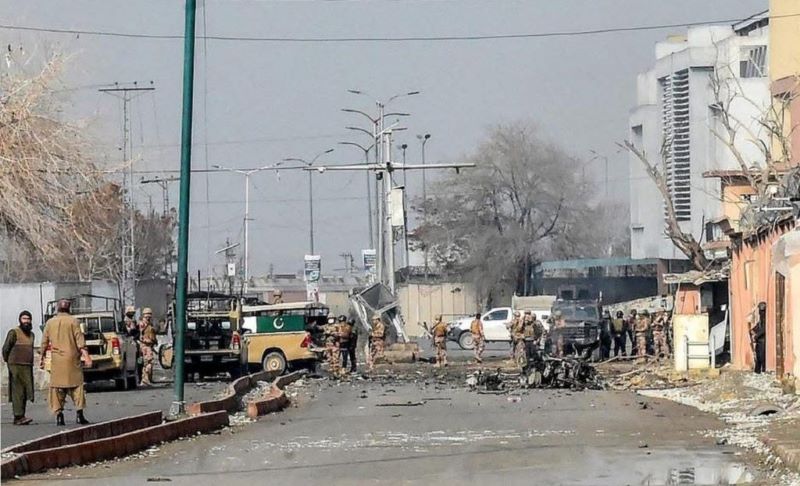
Five months later, that shimmering promise looks increasingly fragile. Saturday’s coordinated attacks across Balochistan killing 31 civilians and 17 security personnel while the military gunned down 145 fighters, delivered a brutal reminder that Pakistan’s richest province is also its most volatile.
A Province of Paradoxes
Balochistan embodies Pakistan’s starkest contradictions. The country’s largest province by area is also its poorest, despite sitting atop mountains of untapped wealth. Beneath its rugged landscape lie significant reserves of oil, coal, gold, copper, and natural gas resources that generate billions for the federal government yet leave the province’s 15 million residents mired in poverty and neglect.
This wealth has made Balochistan central to Pakistan’s economic promises to both Washington and Beijing. China has already poured billions into the province, including developing Gwadar, Pakistan’s only deep-sea port and a crucial link in the $60 billion China-Pakistan Economic Corridor. Last September, a U.S. mining firm signed a $500 million deal to extract minerals from the region.
But Saturday’s violence exposed the fragility of these grand plans. The attacks, claimed by the Baloch Liberation Army (BLA), targeted at least 12 locations simultaneously. Within hours, Interior Minister Mohsin Naqvi pointed fingers at India, claiming without evidence that “India is behind these attacks.” India swiftly rejected the accusation, calling it an attempt to deflect from Pakistan’s “internal failings.”
Roots Running Deep
The conflict in Balochistan didn’t begin yesterday. Annexed by Pakistan in 1948 shortly after partition from India, the province has witnessed separatist rebellions almost since the country’s founding. At least five major uprisings have erupted over the decades. The current phase, which began in the early 2000s, has seen demands for resource control gradually morph into calls for complete independence.
The government’s response has been characteristically heavy-handed. Human rights organizations accuse Pakistani authorities of killing and forcibly disappearing thousands of ethnic Balochs suspected of separatist sympathies. This brutal approach has only deepened resentment, creating a vicious cycle of violence and repression.
Saturday’s attacks were part of the BLA’s “Herof 2.0” operation, a follow up to similar coordinated assaults in August 2024. The violence represents a 26 percent spike from the previous year, with at least 254 attacks recorded in 2024, resulting in over 400 deaths.
The Economic Cost of Unrest
The timing couldn’t be worse for Pakistan’s struggling economy. The country barely avoided default in summer 2023, securing a last minute bailout from the International Monetary Fund, its 25th such rescue. Despite gaining some stability under a new $7 billion IMF program, foreign investment remains anemic. Central bank figures show foreign direct investment plummeted to just $808 million in the first half of fiscal year 2026, down from $1.425 billion the previous year
Saher Baloch, a Berlin based researcher, identifies a “core contradiction” in Pakistan’s strategy: “You cannot court international partners by emphasizing the province’s resources without addressing its political grievances.” She argues that Balochistan’s instability isn’t occasional, it’s structural, rooted in ownership disputes, political exclusion, and militarization.
Large scale extraction projects in such volatile conditions remain viable primarily for “state backed actors like China, not market driven Western investors,” she notes. Even Chinese projects under CPEC have faced repeated attacks, forcing Pakistan to deploy thousands of troops just to secure limited infrastructure.
Blame Games and Reality
While Pakistan insists on Indian involvement, even formally designating Baloch separatist groups as “Fitna al-Hindustan” (Indian mischief), analysts remain skeptical. Abdul Basit, a Singapore based security expert, calls the latest attack “a straight up failure of intelligence and local security apparatus,” noting it was carried out in broad daylight by locals.
Imtiaz Gul, director of an Islamabad based research center, warns bluntly: “No sane national or international investor will risk their money in an extremely volatile situation.”
The question haunting Pakistan is whether it can secure its mineral wealth long enough to extract it or whether Balochistan’s blood will ultimately prove more abundant than its gold.





