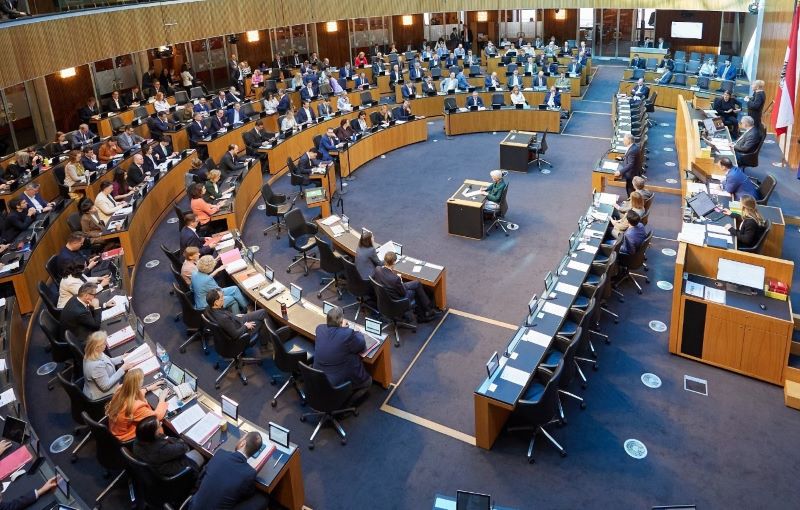
Austria’s National Council opened its critical budget week with fiery exchanges and sharply divided views on the federal government’s proposed twin-year financial plan. At the heart of the debate lies a budget the ruling coalition calls a “grand compromise”—one that aims to balance fiscal consolidation with targeted investments. The proposed framework projects a nationwide deficit of 4.5% of GDP for 2025 and 4.3% in 2026.
Though final approval is expected on Wednesday after a detailed three-day review of each chapter, lawmakers voted Monday to adopt the accompanying budget law. Among its most controversial measures are the elimination of the climate bonus, a higher minimum age for early retirement under the corridor pension, and broader use of electronic monitoring for certain offenders.
FPÖ leader Herbert Kickl railed against the proposal, calling it a “heartless and unimaginative act of butchery.” He accused the government of failing citizens despite record tax revenues and claimed that a fresh wave of burdens loomed in the fall. Kickl blamed immigration, pandemic policies, climate agendas, and military spending for the fiscal crisis, charging that the consequences of these “sins” were being passed on to ordinary Austrians.
The Greens responded more cautiously but echoed discontent. Incoming party leader Leonore Gewessler lamented that climate protection had been reduced to a “sideshow,” describing the budget as political cowardice in numerical form. Party whip Werner Kogler warned that abandoning green transition efforts could trigger EU penalties and job losses.
In contrast, the ÖVP praised the budget as a pivotal shift from crisis-driven spending to fiscal stability. Chancellor Christian Stocker underscored the budget’s dual role—cutting debt while preserving room for investment. Club chairman August Wöginger took aim at Kickl, accusing him of shirking responsibility in favor of populist theatrics.
NEOS leader Yannick Shetty echoed those sentiments, stressing the need to reform “dysfunctional structures” and halt years of unfocused spending. Meanwhile, SPÖ Vice Chancellor Andreas Babler distanced his party from past mismanagement, pledging savings without social erosion. Party chair Philip Kucher emphasized progressive taxation, saying “broad shoulders” must bear more weight to protect the most vulnerable. Finance Minister Markus Marterbauer described the plan as a difficult but necessary convergence of competing interests—“a grand compromise.”