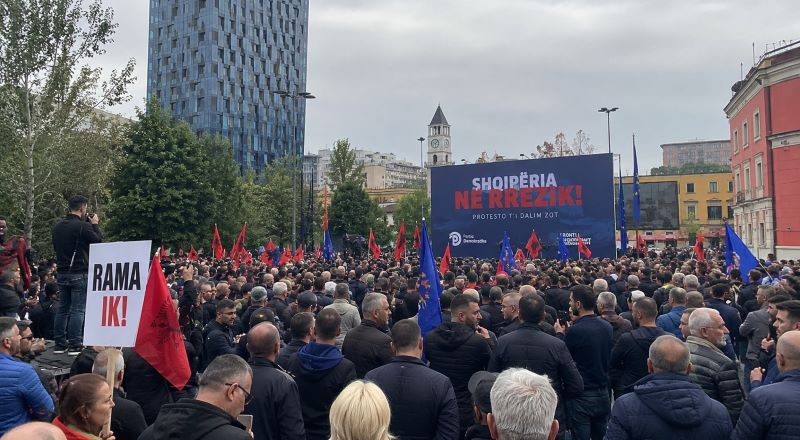
Thousands of people gathered in Tirana on Saturday for a new anti-government rally, reigniting tensions in Albania after days of unrest that had briefly appeared to ease.
The protest began outside the education ministry, a building that has become a symbol of the movement. Soon after it started, some demonstrators threw stones at the ministry, shattering windows already damaged in earlier clashes. Riot police responded with water cannons, tear gas and rubber bullets, reported by Arab News.
The protests, which began in May over a luxury coastal hotel project linked to the family of US President Donald Trump, have grown into a wider movement against corruption and Prime Minister Edi Rama’s government. Protesters are demanding transparency, stronger institutions and Rama’s resignation.
For many young Albanians, the demonstration is about more than politics. “We want to stay in our country and not have to dream of a life elsewhere,” said Rosela Mira, a first-year medical student. Her words reflected a deep anxiety shared by many: that the country’s future is slipping away.
More than 1.5 million people have left Albania since the fall of communism in the 1990s. The population now stands at about 2.3 million, while the average pre-tax salary is around 930 euros a month. Many students say they must work several jobs to support parents living on small pensions.
Teachers, university professors, artists and opposition supporters joined Saturday’s rally, carrying banners reading “No violence,” “Transparency” and “Democracy in danger.” Activist Sidorela Vatnikaj called the movement a “revolution,” saying it was not only about students or environmental concerns, but about the rule of law.
The unrest has been violent at times. Authorities say government buildings have been attacked, dozens of protesters detained, and more than 300 police officers and demonstrators injured since mid October. Albania ranks 91st out of 182 countries in Transparency International’s Corruption Perceptions Index.
Rama has blamed “foreign actors,” including Russia and Iran, for spreading misinformation and fueling violence. He has also called for dialogue, placing red cushions around a concrete table outside government headquarters as a symbolic invitation.
But the gesture failed to calm the crowd. Hundreds of protesters later set the cushions on fire, chanting “Rama in prison” and “Berisha in prison” a sign that public anger is directed not only at the government, but at the entire political class.