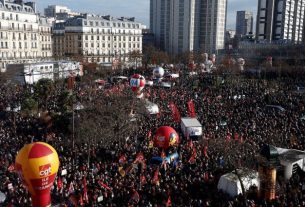
France was gripped by turmoil on Thursday as mass protests over sweeping austerity measures spilled into violence on the streets of Paris. What began as one of the largest union-led demonstrations in years descended into pitched clashes between small groups of masked agitators and heavily deployed police, leaving teargas in the air and hundreds under arrest, according to Euro News.
Tens of thousands marched peacefully through the capital, but chaos erupted in the 11th arrondissement when black-clad demonstrators hurled projectiles at officers. Reporters witnessed bystanders and journalists caught in the crossfire. Police responded with baton charges, clouds of gas, and later stun grenades as the protest line reached Place de la Nation, where chants of “ACAB” and “Get out” rang across the square.
The Interior Ministry reported 181 arrests nationwide by early evening, including 31 in Paris, and said 11 officers had been slightly injured. Outgoing Interior Minister Bruno Retailleau later revised the figure upward, citing 309 arrests, with more than 130 people still in custody.
Union leaders claimed over a million people joined demonstrations across France; authorities put the figure at closer to 500,000, with 50,000 in Paris alone. Eight major unions had called the strike to resist what they describe as “brutal” budget plans—cuts they say will hollow out public services and erode dignity for workers and students alike.
The protests come just days after the collapse of François Bayrou’s government, which had unveiled plans to slash €44 billion in spending by 2026 to rein in a deficit running at nearly double the EU limit. Prime Minister Sébastien Lecornu, newly installed in the wake of the crisis, has scrapped one deeply unpopular idea—abolishing two public holidays—but remains committed to further measures, including curbs on pensions, unemployment benefits, and health coverage.
Travel and schools were badly hit by the strikes. Paris commuter trains and metro services ran at reduced capacity, while high-speed TGV lines remained mostly operational. Nearly half of secondary school teachers walked out, alongside a third of their primary school colleagues. On the Caribbean island of Martinique, 150,000 people were briefly left without water in what officials described as sabotage linked to the unrest.
With 80,000 police deployed nationwide, Paris police chief Laurent Nuñez warned that extremist groups were seeking to infiltrate the marches. Yet many demonstrators said the violence only underscored their message. “We’re living in injustice,” said Alexandre, a protester in Paris. “Workers can’t feed themselves, students have no future. The government doesn’t listen, and that’s why we’re here.”