

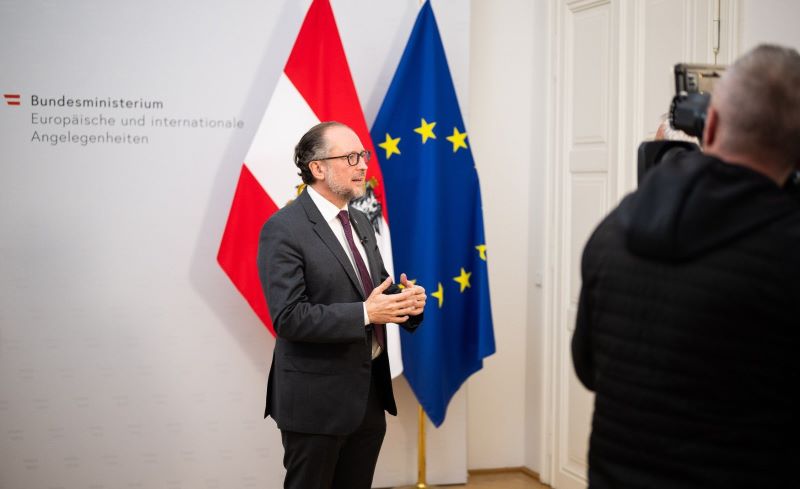
The Austrian Foreign Ministry has issued a circular to its embassies worldwide, addressing international concerns over the potential leadership of Freedom Party (FPÖ) chief Herbert Kickl in a new government. The document, shared as coalition talks between the FPÖ and the conservative Austrian People’s Party (ÖVP) loom, emphasizes Austria’s reliability as a European and global partner. “Austria is and will remain a reliable partner in Europe and the world,” it states, stressing continuity in foreign policy despite political changes.
Interim Chancellor Alexander Schallenberg, who also serves as Foreign Minister, is slated to meet top EU officials, including Council President António Costa and European Parliament President Roberta Metsola, to underline Austria’s commitment to its international obligations.
The circular highlights Austria’s dedication to democracy, the rule of law, human rights, and a rules-based international order, particularly concerning Russia’s war in Ukraine and the Middle East. However, FPÖ rhetoric complicates these assurances, with the party accusing the EU of warmongering and opposing financial support for Ukraine through the European Peace Facility. The FPÖ also calls for reviewing international treaties that may restrict Austrian sovereignty, potentially seeking their termination.
Despite these tensions, the Foreign Ministry reaffirmed Austria’s support for EU integration of Western Balkan nations and Israel’s security, longstanding pillars of Austrian foreign policy. The FPÖ, however, has been critical of Kosovo and remains distanced from Israel, aligning with Vienna’s Jewish community’s stance against the far-right party.
The ministry also reaffirmed Austria’s “clear commitment to the EU and single market,” contrasting the FPÖ’s advocacy for a Europe of sovereign nations and repatriation of powers from Brussels. Observers question whether the FPÖ, if in government, will temper its Euroscepticism and uphold Austria’s traditional diplomatic trajectory. The evolving situation remains a critical test of Austria’s international alignment.





