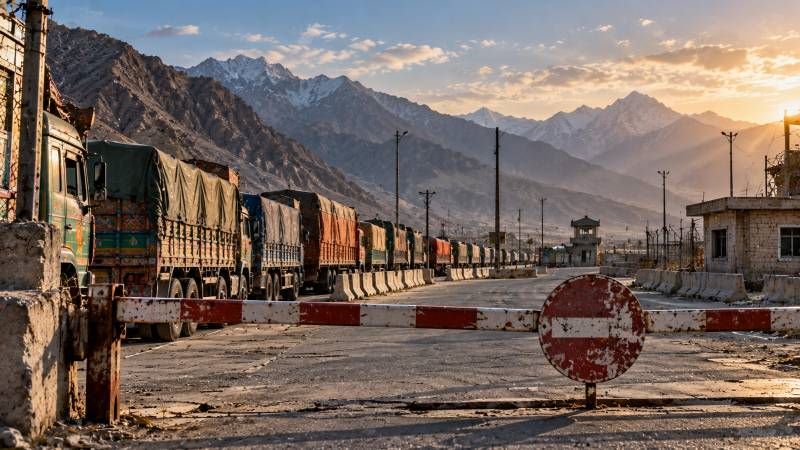
ISLAMABAD: Imagine a house with four neighbors, where three of the doors stay locked. No visits, no trade, no friendly greetings over the fence. This is the quiet reality for Pakistan, where the borders with India, Afghanistan and Iran have largely frozen, leaving some 250 million people living in an uneasy kind of isolation, reported in a news article by The Friday Times Pakistan.
Only a narrow strip of the northern border with China remains open, and even there, travel is tightly restricted. Few countries in the world face such a lonely map.
The break with India deepened on August 5, 2019, when New Delhi revoked the special status of Jammu and Kashmir. Since then, direct trade and travel between the two nations have stopped. Experts say the two economies could exchange about $10 billion in goods, a bridge of opportunity that now lies unused.
On the western side, the story is just as painful. When Pakistan closed its border with Afghanistan, traders on both sides felt the pinch. Pakistan once sold more to Kabul than it bought, so the closure has hurt its own merchants too. Along the Iranian border, communities that lived on trade have watched their livelihoods fade. Tehran’s tensions with the United States, and the pressure that came with them, helped end cooperation, including work on the long-planned Iran-Pakistan gas pipeline.
The numbers tell an uncomfortable tale. India’s economy is growing at roughly 7 percent, with foreign reserves above $700 billion. Pakistan’s growth hovers near 3.5 percent, and its reserves stand at only about $22 billion. India, Afghanistan and Iran have felt the loss of Pakistani trade far less than Pakistan has felt theirs.
Analysts point to a lesson from elsewhere. China and India, despite bitter disputes, still trade around $150 billion a year. If rivals can do business, they ask, why not Pakistan and its neighbors?
The damage reaches beyond money. Closed borders choke tourism and travel, and they feed a quiet loss of talent as young, skilled people look for opportunity abroad. Political instability and weak governance only deepen the strain.
Commentators urge Pakistan to look toward South Asia instead of spending its energy on faraway conflicts in the Middle East. They also call for proper research to measure the true cost of these closures, which is believed to run into billions of dollars each year.
Trade, travel and tourism have long softened hostility between neighbors. With India, that hope has not yet come true. Yet many argue that with political courage and a little less pride on both sides, the doors could open again. India, they say, should take the first step toward dialogue, while Pakistan must work to settle its differences with Kabul and reopen its Iranian frontier.
Until then, a country of 250 million waits behind its own walls, and the silence at its borders grows louder.__Photo Courtesy The Friday Times Pakistan.