

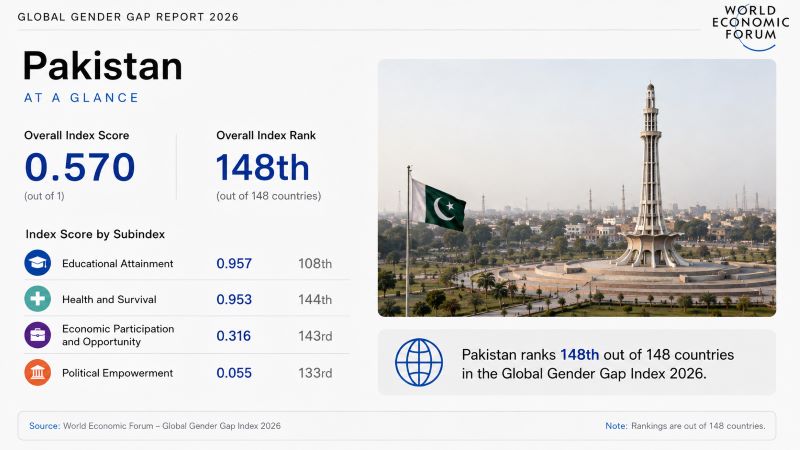
Pakistan has moved up from the bottom of the World Economic Forum’s Global Gender Gap Index 2026, but remains among the worst-performing countries in the world. The South Asian nation now ranks 143rd out of 145 economies, ahead of only Algeria, the Democratic Republic of the Congo, Iran and Chad, after closing 59.5% of its overall gender gap.
The 2026 report records a 2.8 percentage point improvement over last year’s score of 56.7%, marking Pakistan’s strongest year on year gain in a decade. Since the index was first published in 2006, when Pakistan stood at 54.3%, the country’s score has risen by 5.2 points, as reported by The Express Tribune. Last year, Pakistan had finished last among 148 countries assessed on gender mainstreaming.
Education has emerged as the bright spot. Pakistan’s Educational Attainment score jumped to a record 91.7%, up more than six points from the previous edition and 21 points since 2006. The WEF says gains in primary, secondary and tertiary enrolment have been the main driver of progress, with parity across these indicators rising by about 20 percentage points over two decades. In global rankings, Pakistan now leads the world in female enrolment in tertiary education.
Yet these advances have not translated into economic opportunity. Economic Participation and Opportunity remains Pakistan’s weakest area, with a score of just 36.4%, placing it 144th globally and last in South Asia. Gender parity in labour-force participation stands at only 34.6%, and the estimated earned income parity score has fallen to 26.3%, down 7.7 points since 2006. Women make up 44.9% of professional and technical workers but only 6.5% of legislators, senior officials and managers.
Political empowerment shows modest improvement. Pakistan’s score in this category rose to 14.1%, lifting the country to 107th globally and fourth in South Asia. Parity in parliamentary representation increased by 7.1 points and in ministerial roles by 3.6 points, though both remain below historical peaks. The head-of-state indicator has been stuck at 0.104 since 2010, reflecting the fact that Benazir Bhutto remains the only woman to have served as the country’s elected leader.
On Health and Survival, Pakistan performs comparatively well, with a gender parity score of 95.9% and the top global ranking for sex ratio at birth. Even so, the overall picture is uneven; education and health show substantial parity, while economic participation lags far behind. Globally, the WEF estimates that 69.2% of the gender gap has been closed across the 145 economies in the 2026 index. Iceland leads the ranking at 93%, followed by Finland, Norway, Namibia and the United Kingdom.





