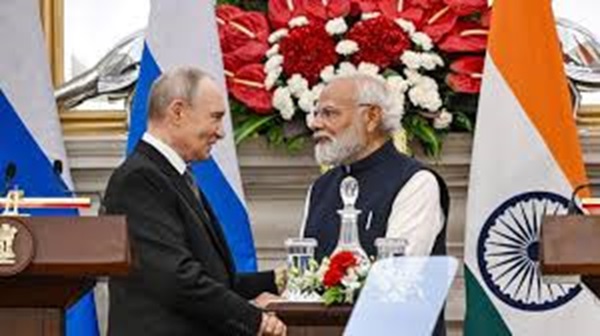
Chandigarh: What went unpublicised during Russian President Vladimir Putin’s India visit last week was the quiet, but unmistakable military subtext: one both sides deliberately avoided mentioning, mindful of possibly triggering US penalties under its 2017 Countering America’s Adversaries Through Sanctions Act (CAATSA).
Military sources said the ‘deliberate absence’ of widely anticipated public announcements of Indo-Russian military commerce, in no way signalled, a slowdown in bilateral defence cooperation between Moscow and New Delhi; it merely reflected India’s desire to avoid a repeat of intense US scrutiny it underwent, for years, during President Donald Trump’s first term as President, prompted by its purchase of five Almaz-Antey S- 400 ‘Triumf’ air-defence systems, in October 2018 for around $5 billion.
That episode brought India perilously close to punitive measures under CAATSA, enacted in 2017 during Trump’s first term to deter countries from engaging in military transactions with Russia’s extensive defence, security, and intelligence sectors. The Act was introduced in response to Russia’s annexation of Crimea in 2014 and Moscow’s alleged interference – eventually unproven – in the US presidential elections two years later.
Under CAATSA, India’s acquisition of the S-400 placed it squarely within the range of potential sanctions, after Washington had previously invoked the law against China in September 2018 and its NATO ally Turkey in December 2020, for their respective purchases of similar Russian air defence systems. In 2019, the US had also ejected Turkey from its F-35 Lightning II 5th-generation stealth fighter programme, amid concerns that the S-400’s radar could compromise the aircraft’s advanced capabilities.