

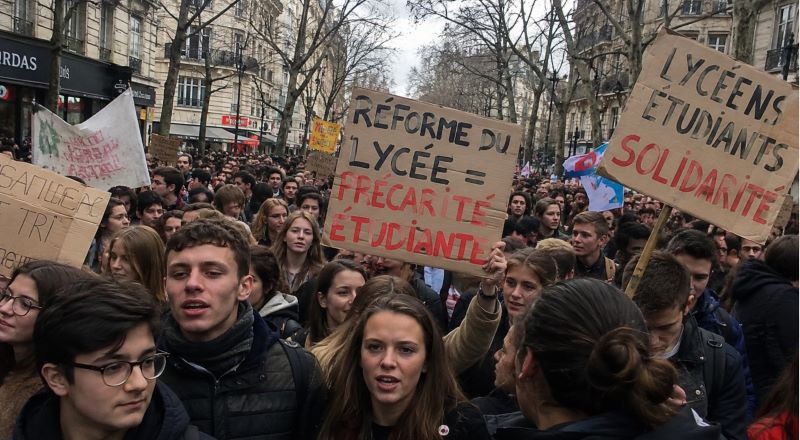
Almost 1,000 people have been arrested during protests across France, according to the interior minister, after a day that began with largely peaceful demonstrations but ended in clashes in several cities, according to BBC News.
Hundreds of thousands of people took to the streets across the country, with police estimating that 110,000 marched in Paris alone. In the capital, some protesters threw objects at police near Porte de Vincennes, while in Marseille barricades were set on fire. In Bordeaux, people tore boards from a shop front.
Police fired tear gas in cities including Lyon and Nantes as tensions rose. For many demonstrators, the day was meant to be a peaceful expression of anger. But as evening fell, isolated groups clashed with officers, turning some streets into scenes of smoke, shouting and running crowds.
The protests follow a weekend of riots and looting across France, during which more than 2,700 people were arrested. While Saturday’s violence was serious, observers noted that it did not reach the same scale of chaos as the previous disturbances.
The demonstrations reflect deep frustration in French society. Many protesters say they are angry over inequality, policing, and a sense that their voices are not being heard by political leaders. For others, the marches are a way to demand change after days of tension that have left communities shaken.
Interior Minister said the nearly 1,000 arrests showed the scale of the challenge facing police. Authorities have urged protesters to remain peaceful, warning that violence risks overshadowing the message of the demonstrations.
In Paris, tear gas drifted through the air as police and protesters faced off in tense standoffs. Yet despite the confrontations, many marchers continued to call calmly for justice and reform.
France now faces a familiar question: how to respond to public anger without allowing peaceful protest to descend into further violence. For the government, the answer may determine whether the country moves toward dialogue or deeper unrest.





