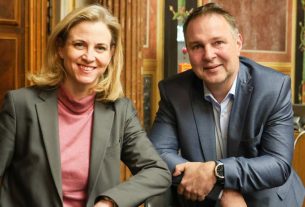
Austrian Europe Minister Claudia Bauer has questioned whether the European Union should continue dealing with issues that mainly belong to its member states. In an interview with the Austrian Press Agency, she called for a leaner and more effective EU, a smaller European Commission and a reduced long-term budget.
Bauer said the EU had created structures in areas where national governments still held full responsibility. She mentioned youth, generations, housing, sport and culture as examples. In her view, the Union should focus on matters where joint European action is truly necessary and reduce structures that have expanded over the years without having real decision-making powers
The minister again supported the introduction of a smaller European Commission, especially as the EU prepares its budget for 2028 to 2034 and considers possible future enlargement. She suggested a rotation system that would allow the Commission to concentrate more closely on genuine EU responsibilities. Bauer argued that there was no need for additional commissioners and large administrative departments dealing with areas that were not primarily European competences, reported by The oe24.
Austria and eight other EU countries have opposed the Commission’s proposal to increase administrative and personnel spending by 39 percent. Bauer described the plan as inconsistent with the EU’s promises of greater digitalisation, more e-government, increased automation and less bureaucracy.
She also identified possible savings by merging the EU’s many funding programmes. According to Bauer, Europe has created numerous separate funds, particularly in the field of competitiveness. Instead of establishing new funds, she said, the EU should reduce bureaucracy. She also urged the Union to attract more private investment through the capital markets union. Every year, around 300 billion euros in European savings are invested outside the EU, especially in the United States.
Austria wants the proposed EU budget, which is almost two trillion euros, to be reduced. Vienna also insists that its national contribution remain stable and that its rebate continue. Bauer said Austria would remain open to new EU sources of income, but warned that a proposed company levy must not place an additional burden on businesses or weaken the country’s economic position.
She declined to predict whether a budget agreement could be reached this year. New figures are expected in October, after which Austria will assess the chances of a final deal. Bauer stressed that there would be “no agreement at any price”, while making clear that Austria was not currently threatening to use its veto.
Bauer also welcomed the possibility that Iceland could resume its EU accession process after its referendum. If Iceland fulfils the necessary conditions, she said it could perhaps join the Union at the same time as Montenegro. Such a development would symbolise EU growth in both the North Atlantic and the Western Balkans.
Regarding Ukraine, Bauer warned that membership negotiations could take more than a decade, and possibly up to 20 years. Because Ukraine is still at war, she believes its accession process could be at least as long as those of Western Balkan countries. She added that no fixed date for Ukraine’s EU membership should be promised at the beginning of negotiations.